THEO PARKEMUSIC
Storyboard · Die Geschichte der RockoperThe story of the rock operaИстория рок-оперыLa historia de la ópera rock

The Crown Cycle

28 Szenen in drei Teilen – vom Morgen nach der letzten Schlacht im Jahr 76 bis zum Fluss des Lebens. Jede Szene gehört zu einem Song; zum Anhören führt der Link unter dem Text.28 scenes in three parts – from the morning after the last battle in AD 76 to the river of life. Every scene belongs to a song; the link below the text takes you there.28 сцен в трёх частях – от утра после последней битвы в 76 году до реки жизни. Каждая сцена – это песня; ссылка под текстом ведёт к ней.28 escenas en tres partes – desde la mañana después de la última batalla en el año 76 hasta el río de la vida. Cada escena pertenece a una canción; el enlace bajo el texto lleva a ella.

Track 0 · Zum Lesen hörenTrack 0 · Listen while you readТрек 0 · Слушайте во время чтенияPista 0 · Escuche mientras lee
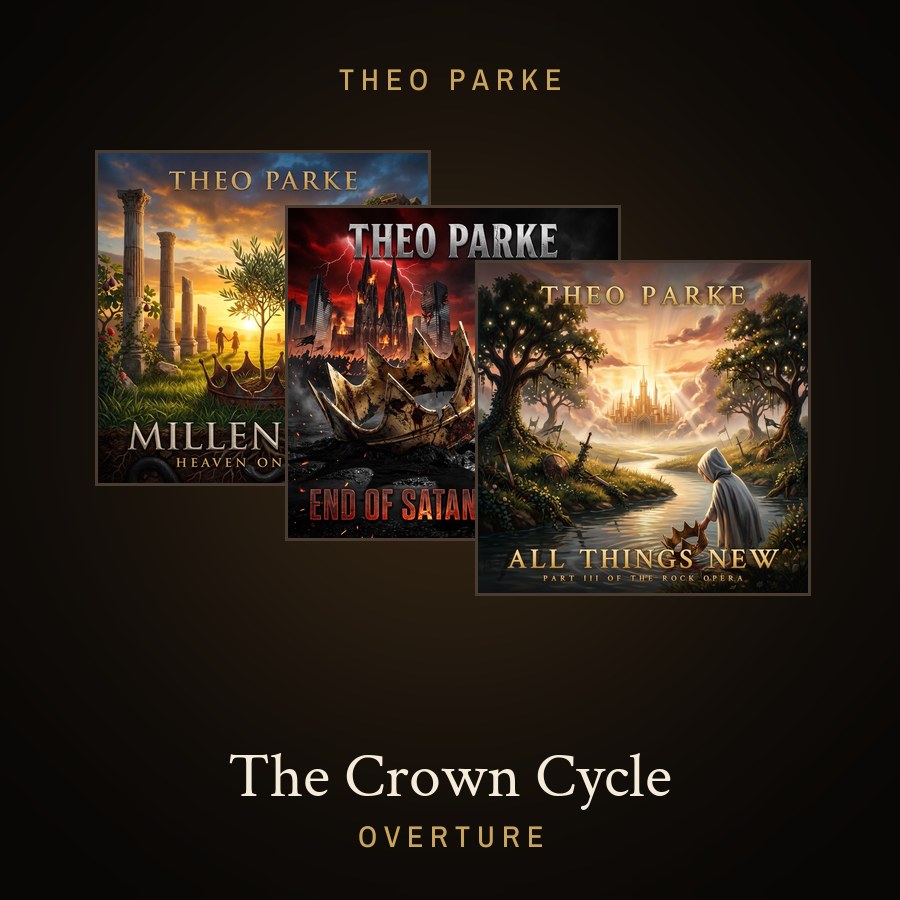
The Crown Cycle (Overture)
PrologPrologueПрологPrólogo

Es gibt Geschichten, die man erzählt, und Geschichten, die einen erzählen. Diese gehört zur zweiten Art. Sie beginnt im Jahr 76 auf einem Schlachtfeld, das niemand mehr verteidigen will, und sie endet an einem Fluss, der aus einem Thron entspringt. Dazwischen liegen tausend Jahre Frieden, eine kurze Zeit der Verführung, eine Welt, die ihre Engel verkauft, und ein letzter Krieg zweier Kronen, die einander so ähnlich sind wie zwei Hälften derselben Münze.

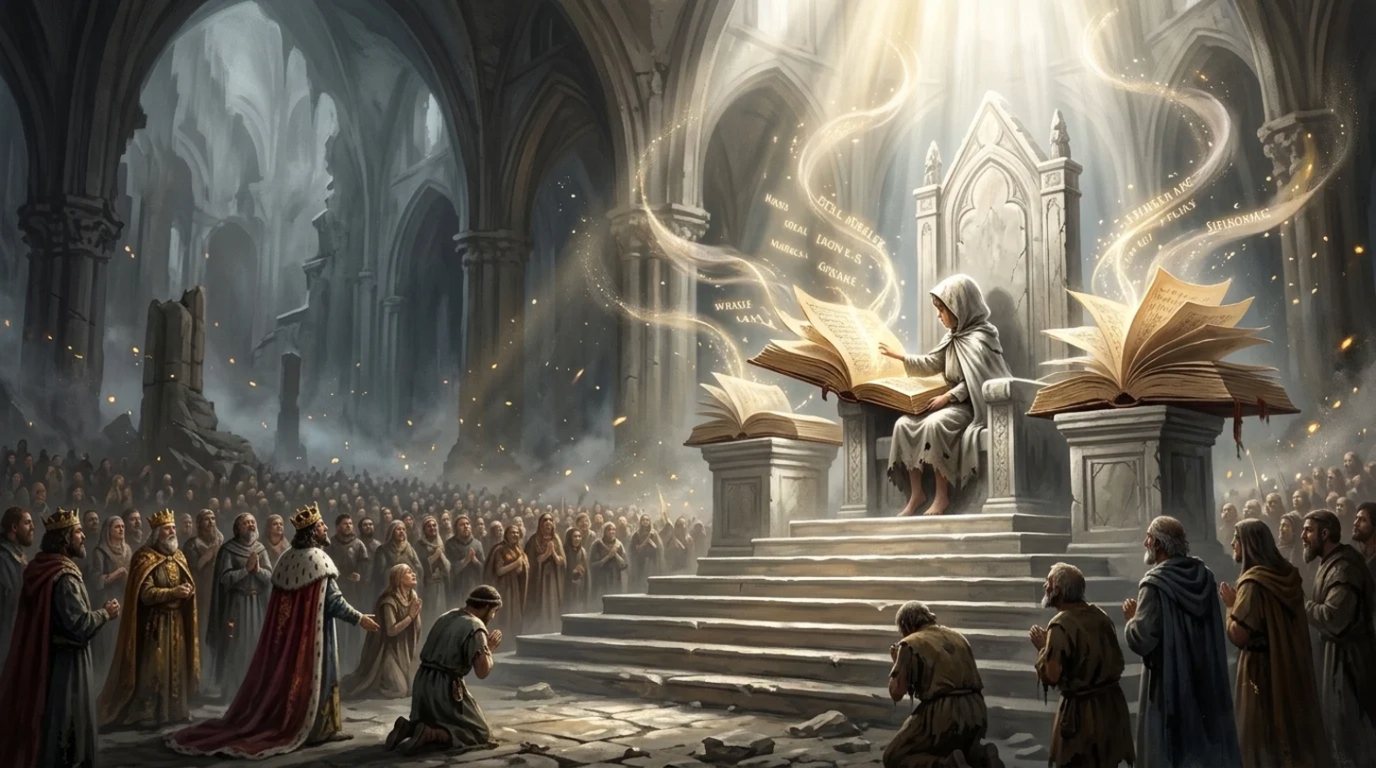
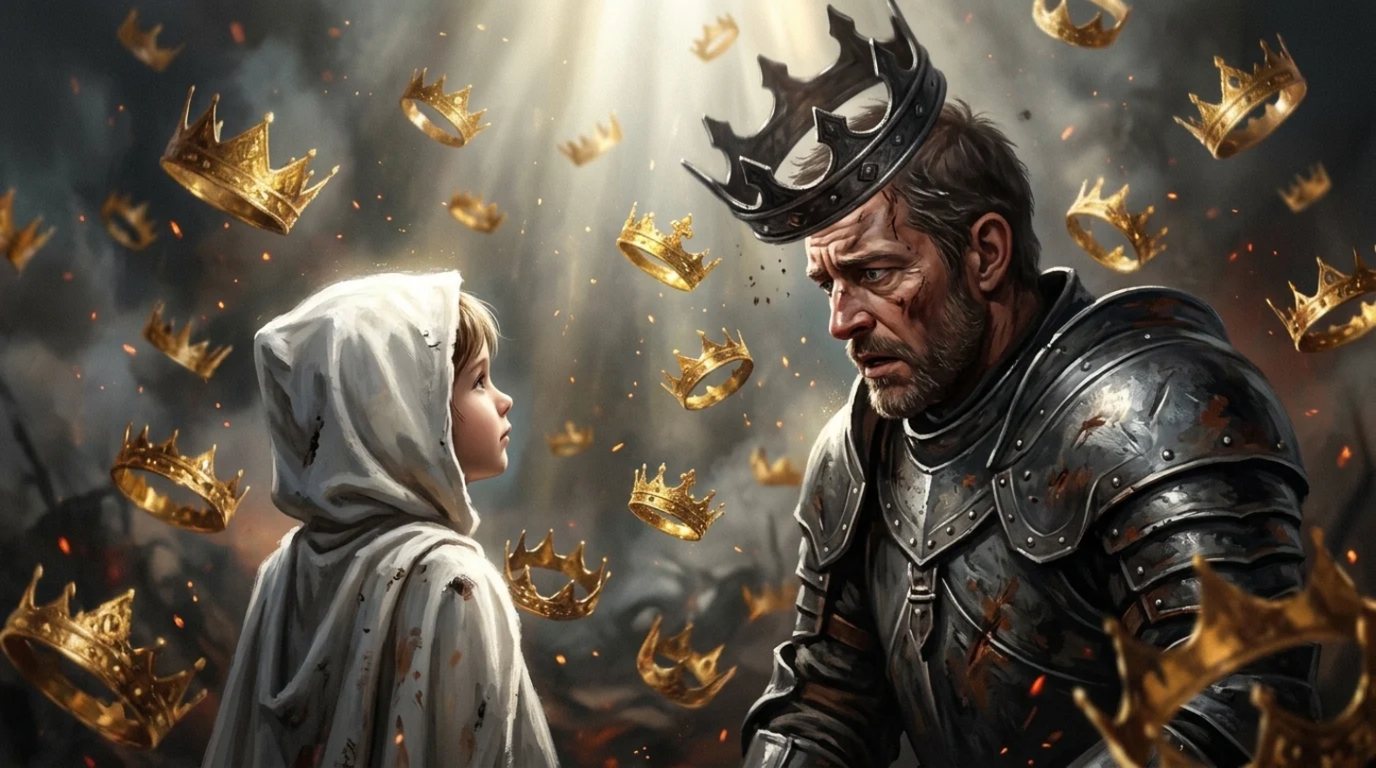
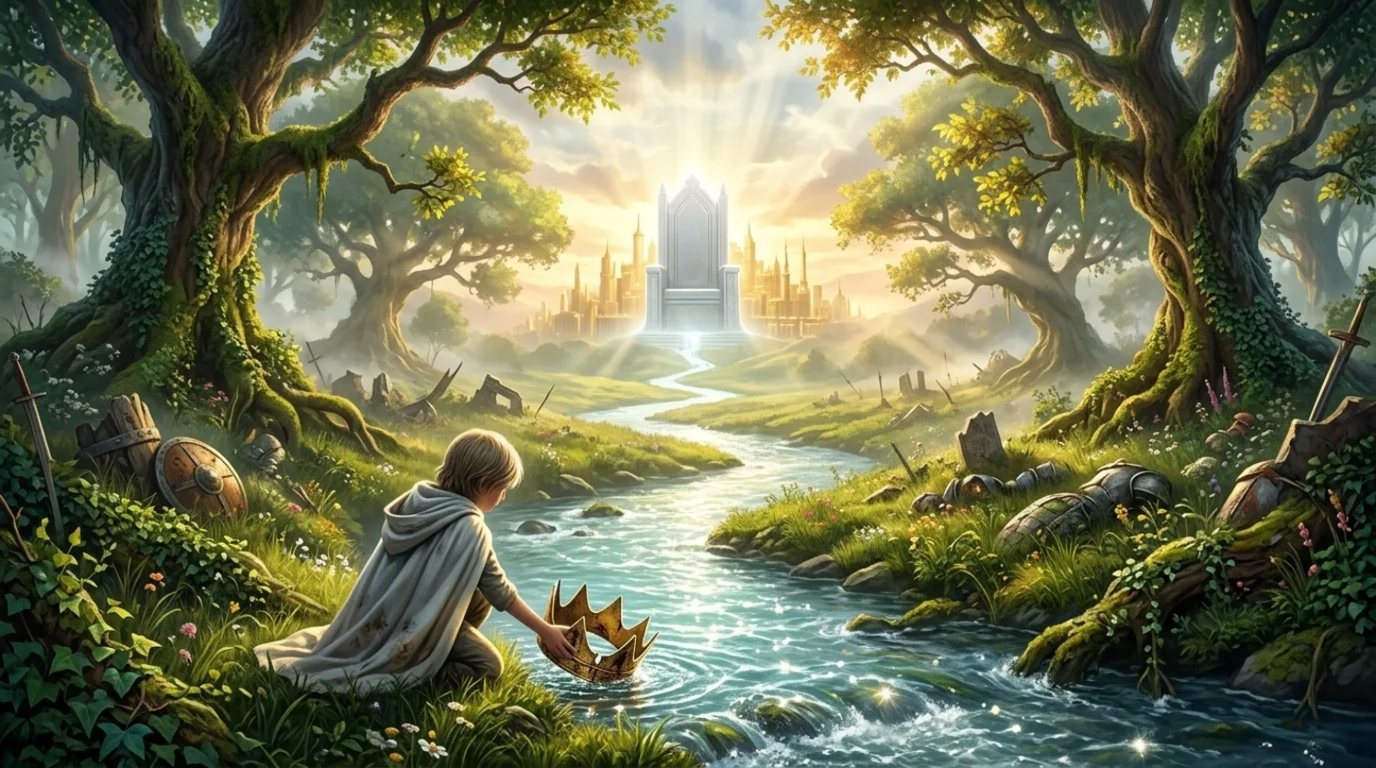
Durch alle Zeiten geht eine Gestalt, die kaum jemand bemerkt: klein, in einem weißen Mantel, mit leeren Händen. Sie steht am Anfang neben einer verwundeten Frau, sie geht durch die Ruinen, als die Mächtigen schon wieder Pläne schmieden, und sie steigt am Ende die Stufen eines Throns hinauf, auf den sich kein König mehr setzen konnte.

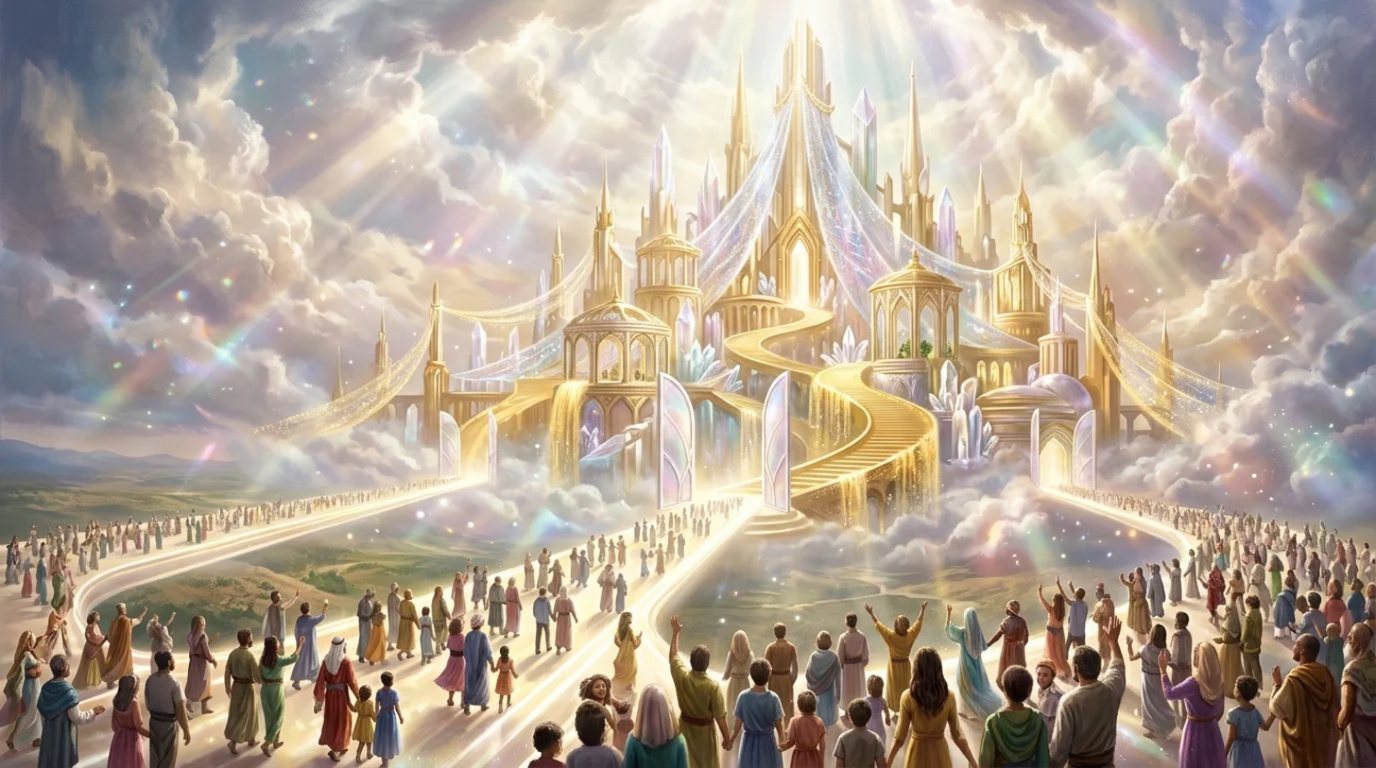
Dies ist The Crown Cycle. Drei Teile, eine Frage. Wer sie hört, wird sie nicht mehr los: Wer bist du, wenn die Kronen fallen?

There are stories one tells, and stories that tell the one who hears them. This is a story of the second kind. It begins in AD 76 on a battlefield no one wishes to defend any longer, and it ends at a river that springs from a throne. Between the two lie a thousand years of peace, a brief season of seduction, a world that sells its angels, and a last war between two crowns as alike as the two faces of a single coin.

Through all the ages walks a figure hardly anyone notices: small, in a white cloak, with empty hands. At the beginning it stands beside a wounded woman; it walks through the ruins while the powerful are already drawing up new plans; and at the end it climbs the steps of a throne on which no king was able to sit.

This is The Crown Cycle. Three parts, one question. Whoever hears it can never again let it go: Who are you when the crowns fall?

Есть истории, которые рассказываем мы, и есть истории, которые рассказывают нас. Эта – из вторых. Она начинается в 76 году на поле битвы, которое больше никто не хочет защищать, и заканчивается у реки, что берёт начало от престола. Между ними – тысяча лет мира, недолгая пора соблазна, мир, продающий своих ангелов, и последняя война двух корон, похожих друг на друга, как две стороны одной монеты.

Сквозь все времена проходит фигура, которую почти никто не замечает: маленькая, в белом плаще, с пустыми руками. В начале она стоит рядом с раненой женщиной, потом идёт среди руин, когда сильные мира уже снова строят планы, а в конце поднимается по ступеням престола, на который не смог сесть ни один король.

Это The Crown Cycle. Три части, один вопрос. Кто однажды его услышит, тот уже от него не освободится: Кто ты, когда падают короны?

Hay historias que uno cuenta e historias que lo cuentan a uno. Esta pertenece a la segunda clase. Comienza en el año 76, en un campo de batalla que ya nadie quiere defender, y termina junto a un río que brota de un trono. Entre ambos extremos hay mil años de paz, un breve tiempo de seducción, un mundo que vende a sus ángeles y una última guerra entre dos coronas tan parecidas como las dos caras de una misma moneda.

A través de todas las épocas camina una figura que casi nadie advierte: pequeña, envuelta en un manto blanco, con las manos vacías. Al principio está junto a una mujer herida; recorre las ruinas cuando los poderosos ya vuelven a tramar sus planes; y al final sube los peldaños de un trono en el que ningún rey pudo sentarse.

Esto es The Crown Cycle. Tres partes, una pregunta. Quien la oye ya no puede librarse de ella: ¿Quién eres cuando caen las coronas?

TeilPartЧастьParte I · Jahr 76 bis 1076AD 76 to 107676–1076 годыAño 76 a 1076

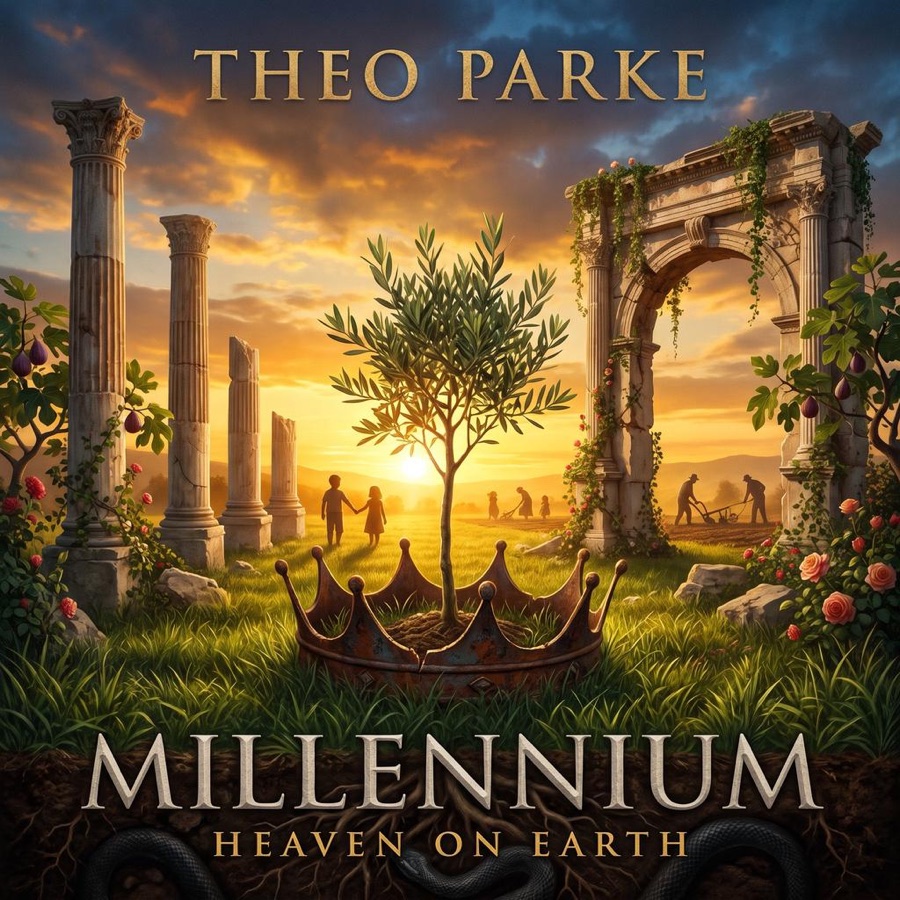
Millennium – Heaven on Earth

Teil I der Geschichte · Jahr 76 bis 1076Part I of the story · AD 76 to 1076Часть I истории · 76–1076 годыParte I de la historia · año 76 a 1076

Der erste Teil erzählt von einem Wunder, das sich niemand verdient hat. Nach der letzten Schlacht eines alten Weltreichs legen die Überlebenden ihre Waffen nieder – nicht aus Schwäche, sondern weil sie gesehen haben, wohin die Kronen führen. Sie schmieden Pflüge aus Schwertern, machen Paläste zu Schulen und schwören, nie wieder einem König zu dienen. Tausend Jahre lang hält dieser Schwur. Kinder singen ihn, Bauern leben ihn, Generationen wachsen in seinem Schatten auf. Doch tief unter dem Garten liegt etwas und wartet. Und als das Jahrtausend sich neigt, beginnen die Menschen zu vergessen, warum sie einst geschworen haben.

The first part tells of a miracle no one had earned. After the last battle of an ancient empire, the survivors lay down their weapons – not out of weakness, but because they have seen where crowns lead. They beat their swords into ploughshares, turn palaces into schools, and swear never again to serve a king. For a thousand years the oath holds. Children sing it, farmers live it, generations grow up in its shade. Yet deep beneath the garden something lies and waits. And as the millennium draws to its close, people begin to forget why they once swore.

Первая часть рассказывает о чуде, которого никто не заслужил. После последней битвы древней мировой империи уцелевшие складывают оружие – не от слабости, а потому, что видели, куда ведут короны. Они перековывают мечи на орала, превращают дворцы в школы и клянутся никогда больше не служить ни одному королю. Тысячу лет держится эта клятва. Дети поют её, крестьяне живут ею, поколения вырастают в её тени. Но глубоко под садом лежит нечто и ждёт. И когда тысячелетие клонится к закату, люди начинают забывать, зачем когда-то клялись.

La primera parte narra un milagro que nadie había merecido. Tras la última batalla de un antiguo imperio, los sobrevivientes deponen las armas, no por debilidad, sino porque han visto adónde conducen las coronas. Forjan arados de las espadas, convierten los palacios en escuelas y juran no volver a servir jamás a ningún rey. Durante mil años se mantiene ese juramento. Los niños lo cantan, los campesinos lo viven, generaciones enteras crecen a su sombra. Pero en lo hondo, bajo el jardín, algo yace y espera. Y cuando el milenio declina, los hombres empiezan a olvidar por qué juraron un día.

I.01 · Jahr 76AD 7676 годaño 76

The Morning After

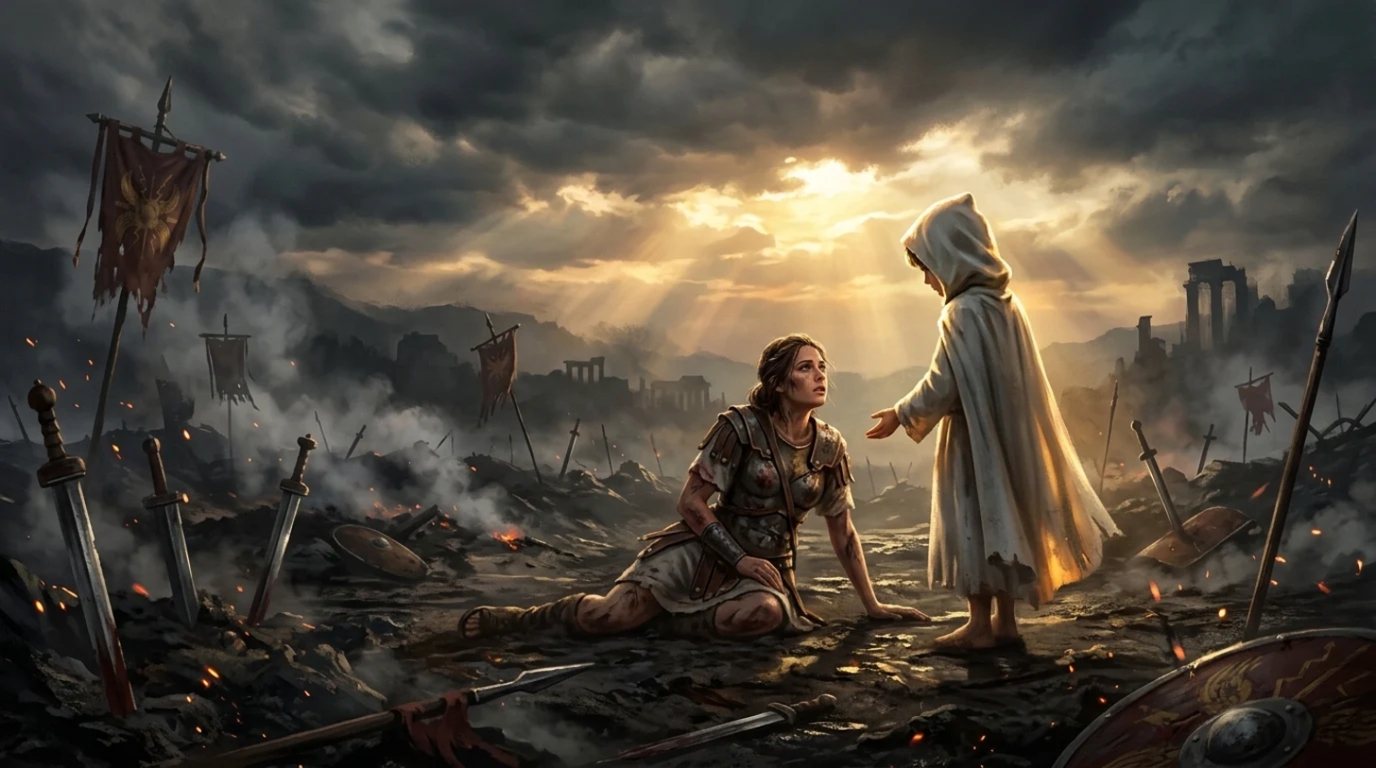
Jahr 76. Der Morgen nach der letzten Schlacht ist so still, dass man den Rauch hören kann, wie er über das Feld zieht. Schwerter liegen kalt im Gras, Schilde mit dem Adler des Reiches, zerbrochene Lanzen, Pferde, die nicht mehr aufstehen. Zwischen ihnen hebt eine junge Frau den Kopf. Sie ist verwundet, ihr Mantel ist schwarz vom Ruß, und sie weiß nicht, auf welcher Seite sie gekämpft hat – nur, dass beide verloren haben.

Im Osten reißen die Wolken auf. Ein Streifen Gold fällt über das Feld, erst schmal, dann breit wie ein Fluss. Und im Licht steht eine kleine Gestalt in einem weißen Mantel mit Kapuze. Niemand hat sie kommen sehen. Sie trägt keine Waffe, kein Zeichen, kein Banner. Sie streckt nur die Hand aus.

Die Frau zögert. Wer hilft hier noch, wem nützt hier noch etwas? Dann nimmt sie die Hand und steht auf. Hinter ihr liegen die Mauern der Stadt in Trümmern, und zum ersten Mal seit Generationen braucht sie niemand mehr. Die Welt ist nicht gerettet. Aber sie ist neu geboren, an diesem Morgen, im Jahr 76.

AD 76. The morning after the last battle is so still that you can hear the smoke drifting across the field. Swords lie cold in the grass, shields bearing the eagle of the empire, broken lances, horses that will not rise again. Among them a young woman lifts her head. She is wounded, her cloak black with soot, and she does not know which side she fought for – only that both have lost.

In the east the clouds tear open. A band of gold falls across the field, narrow at first, then broad as a river. And in the light stands a small figure in a white hooded cloak. No one saw it come. It carries no weapon, no emblem, no banner. It only holds out its hand.

The woman hesitates. Who is left here to help, and what is left here to help anyone? Then she takes the hand and rises. Behind her the walls of the city lie in rubble, and for the first time in generations no one needs them anymore. The world has not been saved. But it has been born anew, on this morning, in AD 76.

76 год. Утро после последней битвы так тихо, что слышно, как дым тянется над полем. Мечи холодно лежат в траве, щиты с орлом империи, сломанные копья, кони, которым уже не подняться. Среди них поднимает голову молодая женщина. Она ранена, плащ её чёрен от копоти, и она не знает, на чьей стороне сражалась, – знает лишь, что проиграли обе.

На востоке разрываются облака. Полоса золота ложится на поле, сперва узкая, потом широкая, как река. И в этом свете стоит маленькая фигура в белом плаще с капюшоном. Никто не видел, как она пришла. У неё нет ни оружия, ни знака, ни знамени. Она лишь протягивает руку.

Женщина медлит. Кто здесь ещё станет помогать, кому здесь ещё что-нибудь поможет? Потом она берёт эту руку и встаёт. Позади неё лежат в руинах стены города, и впервые за многие поколения они никому больше не нужны. Мир не спасён. Но он рождён заново – этим утром, в 76 году.

Año 76. La mañana que sigue a la última batalla es tan silenciosa que se oye el humo deslizarse sobre el campo. Las espadas yacen frías en la hierba; escudos con el águila del imperio, lanzas rotas, caballos que ya no se levantarán. Entre ellos, una mujer joven alza la cabeza. Está herida, su manto está negro de hollín, y no sabe en qué bando ha luchado; solo sabe que ambos han perdido.

Al oriente se desgarran las nubes. Una franja de oro cae sobre el campo, angosta al principio, luego ancha como un río. Y en la luz aparece una pequeña figura con un manto blanco y capucha. Nadie la ha visto llegar. No lleva arma, ni insignia, ni estandarte. Solo extiende la mano.

La mujer vacila. ¿Quién ayuda todavía aquí, a quién le sirve ya de algo? Luego toma la mano y se pone en pie. Detrás de ella, las murallas de la ciudad yacen en ruinas, y por primera vez en generaciones nadie las necesita. El mundo no está salvado. Pero ha vuelto a nacer, esta mañana, en el año 76.
Song anhörenListen to the songСлушать песнюEscuchar la canción →
I.02 · Jahr 76AD 7676 годaño 76

Swords into Ploughshares

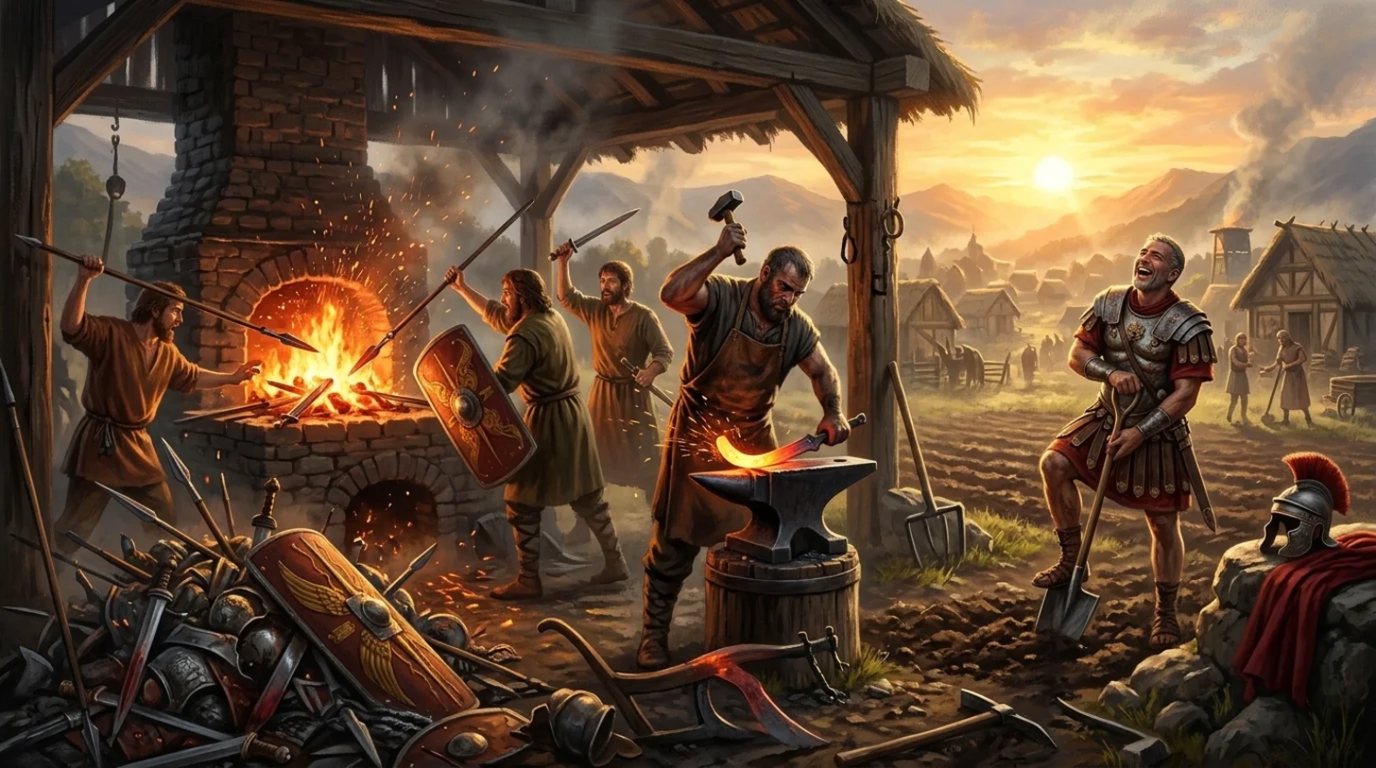
Am dritten Tag brennt in der Schmiede ein Feuer, wie es das Dorf noch nie gesehen hat. Die Überlebenden bringen alles, was sie auf dem Schlachtfeld finden: Speere, Legionärsschwerter, Helme, Pfeilspitzen, Ketten. Der Schmied, ein Mann mit verbrannten Armen und einem Lachen wie ein Donnerschlag, wirft eins nach dem anderen in die Glut.

Der Amboss klingt den ganzen Tag. Die Frauen singen dazu, die Männer schlagen den Takt mit den Hämmern, und die Kinder tragen die Kohlen. Aus jedem Schwert wird eine Pflugschar, aus jedem Speer eine Sichel, aus jedem Helm eine Schale für Brot. Was gestern noch tötete, soll morgen die Erde aufbrechen.

Am Abend geht ein alter General über den Acker hinter der Schmiede. Er hat dreißig Jahre lang Befehle gegeben. Jetzt hält er einen Pflug, den man aus seinem eigenen Schwert geschmiedet hat, und zieht eine erste, krumme Furche durch den Boden. Er stolpert, er flucht, er fängt sich – und dann lacht er, laut und atemlos, wie ein Schuljunge am ersten warmen Tag. Die anderen lachen mit. Es ist das erste Lachen nach dem Krieg, und niemand im Dorf wird es je vergessen.

On the third day a fire burns in the smithy such as the village has never seen. The survivors bring everything they can find on the battlefield: spears, legionaries’ swords, helmets, arrowheads, chains. The smith, a man with burned arms and a laugh like a thunderclap, throws them into the embers one after another.

The anvil rings all day long. The women sing to it, the men beat time with their hammers, and the children carry the coal. Every sword becomes a ploughshare, every spear a sickle, every helmet a bowl for bread. What killed yesterday shall break open the earth tomorrow.

In the evening an old general walks across the field behind the smithy. For thirty years he gave orders. Now he holds a plough forged from his own sword and draws a first, crooked furrow through the soil. He stumbles, he curses, he steadies himself – and then he laughs, loud and breathless, like a schoolboy on the first warm day of the year. The others laugh with him. It is the first laughter after the war, and no one in the village will ever forget it.

На третий день в кузнице горит огонь, какого деревня ещё не видала. Уцелевшие несут всё, что находят на поле битвы: копья, легионерские мечи, шлемы, наконечники стрел, цепи. Кузнец, человек с обожжёнными руками и смехом, похожим на раскат грома, бросает в жар одно за другим.

Наковальня звенит весь день. Женщины поют, мужчины отбивают такт молотами, дети носят уголь. Из каждого меча выходит лемех, из каждого копья – серп, из каждого шлема – чаша для хлеба. То, что вчера ещё убивало, завтра должно вспахивать землю.

Вечером старый генерал идёт по пашне за кузницей. Тридцать лет он отдавал приказы. Теперь он держит плуг, выкованный из его собственного меча, и проводит по земле первую, кривую борозду. Он спотыкается, чертыхается, удерживается – и вдруг смеётся, громко и задыхаясь, как школьник в первый тёплый день. Остальные смеются вместе с ним. Это первый смех после войны, и никто в деревне его никогда не забудет.

Al tercer día arde en la fragua un fuego como la aldea no ha visto jamás. Los sobrevivientes traen todo lo que encuentran en el campo de batalla: venablos, espadas de legionario, yelmos, puntas de flecha, cadenas. El herrero, un hombre de brazos quemados y risa de trueno, los arroja uno tras otro a las brasas.

El yunque resuena el día entero. Las mujeres cantan, los hombres marcan el compás con los martillos y los niños acarrean el carbón. De cada espada sale una reja de arado, de cada lanza una hoz, de cada yelmo un cuenco para el pan. Lo que ayer mataba ha de abrir mañana la tierra.

Al caer la tarde, un viejo general camina por el campo detrás de la fragua. Durante treinta años ha dado órdenes. Ahora sostiene un arado forjado con su propia espada y traza un primer surco, torcido, en el suelo. Tropieza, maldice, recobra el equilibrio, y entonces se ríe, fuerte y sin aliento, como un colegial en el primer día cálido del año. Los demás ríen con él. Es la primera risa después de la guerra, y nadie en la aldea la olvidará jamás.

Song anhörenListen to the songСлушать песнюEscuchar la canción →
I.03 · Jahr 80AD 8080 годaño 80

No More Kings

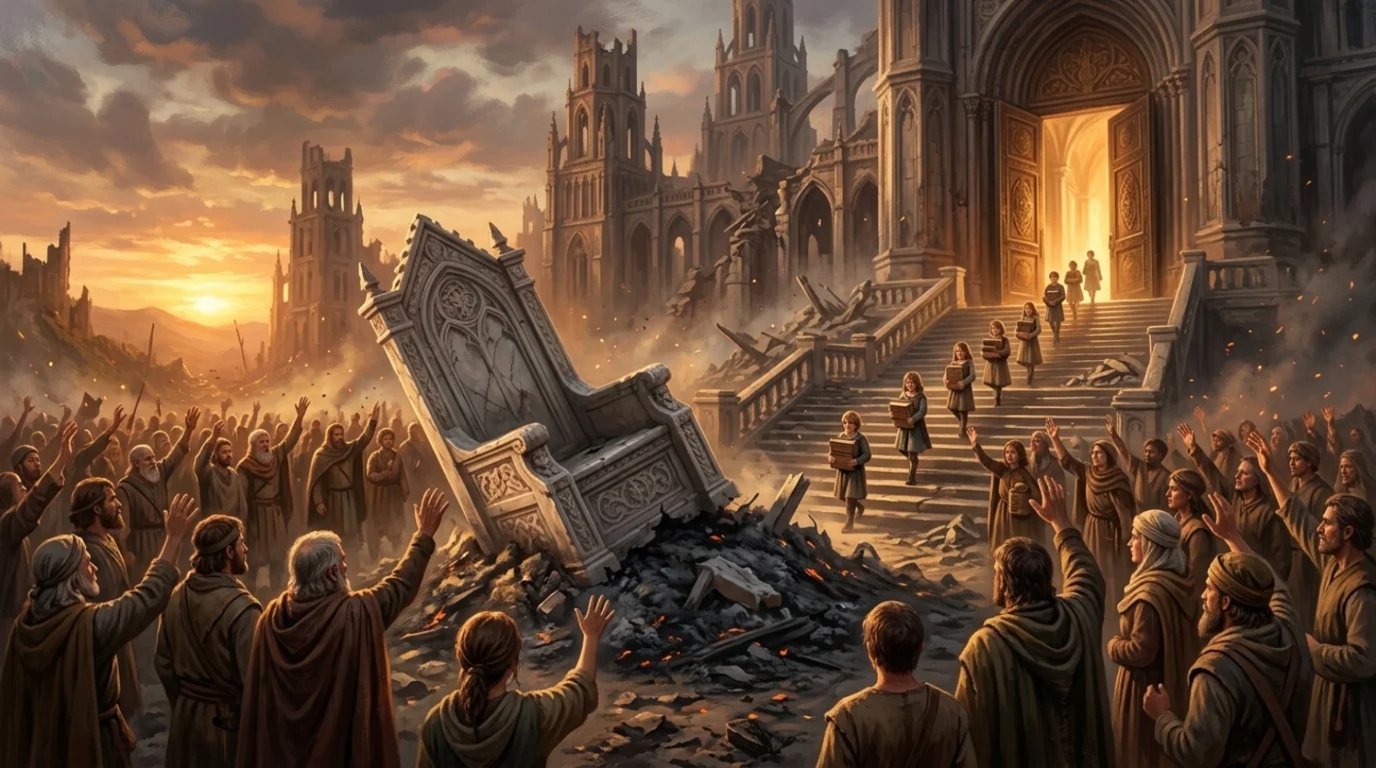
Jahr 80. Der Thron des Statthalters steht noch, aber er ist verkohlt, und um ihn herum hat sich das ganze Volk versammelt. Niemand ruft nach einem neuen Herrn. Stattdessen steigt eine Frau auf die Stufen – dieselbe, die am Morgen nach der Schlacht aufgestanden ist – und spricht den Satz, den alle seit Monaten denken: Niemand soll je wieder über uns herrschen.

Das Volk wiederholt ihn, erst leise, dann laut, dann wie ein Gebet. Es ist kein Aufstand, es ist ein Eid. Jeder legt die Hand auf die Asche des Throns, Bauern, Händler, Schmiede, Soldaten, die gestern noch Feinde waren.

In den Wochen danach verwandelt sich die Stadt. Der Palast des Statthalters wird zur Schule; in den Hallen, in denen Urteile gesprochen wurden, lernen jetzt Kinder lesen. Der Kerker unter dem Palast wird zur Bibliothek, und die Zellen, in denen Menschen verschwunden sind, füllen sich mit Büchern. Wer führt uns jetzt?, fragt ein Junge. Die Frau zeigt auf die Menge: Jeder von uns. Und für eine sehr lange Zeit ist das die Wahrheit.

AD 80. The governor’s throne still stands, but it is charred, and the whole people has gathered around it. No one calls for a new master. Instead a woman climbs the steps – the same woman who rose on the morning after the battle – and speaks the sentence everyone has been thinking for months: No one shall ever rule over us again.

The people repeat it, softly at first, then aloud, then like a prayer. It is not an uprising; it is an oath. Each of them lays a hand on the ashes of the throne – farmers, merchants, smiths, soldiers who only yesterday were enemies.

In the weeks that follow, the city is transformed. The governor’s palace becomes a school; in the halls where sentences were once passed, children now learn to read. The dungeon beneath the palace becomes a library, and the cells in which people vanished fill up with books. Who will lead us now?, a boy asks. The woman points to the crowd: Every one of us. And for a very long time, that is the truth.

80 год. Трон наместника ещё стоит, но он обуглен, и вокруг него собрался весь народ. Никто не зовёт нового господина. Вместо этого на ступени поднимается женщина – та самая, что встала наутро после битвы, – и произносит слова, которые все думают уже много месяцев: «Никто и никогда больше не будет властвовать над нами».

Народ повторяет их, сперва тихо, потом громко, потом как молитву. Это не восстание, это клятва. Каждый кладёт руку на пепел трона – крестьяне, торговцы, кузнецы, солдаты, что ещё вчера были врагами.

В следующие недели город преображается. Дворец наместника становится школой; в залах, где выносили приговоры, теперь дети учатся читать. Темница под дворцом становится библиотекой, и камеры, в которых исчезали люди, наполняются книгами. «Кто же теперь поведёт нас?» – спрашивает мальчик. Женщина указывает на толпу: «Каждый из нас». И очень долгое время это остаётся правдой.

Año 80. El trono del gobernador sigue en pie, pero está carbonizado, y a su alrededor se ha congregado el pueblo entero. Nadie clama por un nuevo señor. En su lugar, una mujer sube los peldaños —la misma que se levantó la mañana después de la batalla— y pronuncia la frase que todos llevan meses pensando: «Que nadie vuelva a reinar jamás sobre nosotros».

El pueblo la repite, primero en voz baja, luego en voz alta, luego como una oración. No es una revuelta, es un juramento. Cada uno pone la mano sobre las cenizas del trono: campesinos, mercaderes, herreros, soldados que ayer todavía eran enemigos.

En las semanas siguientes la ciudad se transforma. El palacio del gobernador se convierte en escuela; en las salas donde se dictaban sentencias, ahora los niños aprenden a leer. La mazmorra bajo el palacio se convierte en biblioteca, y las celdas donde desaparecían personas se llenan de libros. «¿Quién nos guía ahora?», pregunta un muchacho. La mujer señala a la multitud: «Cada uno de nosotros». Y durante muchísimo tiempo esa es la verdad.

Song anhörenListen to the songСлушать песнюEscuchar la canción →
I.04 · Jahr 100AD 100100 годaño 100

The Children Sing

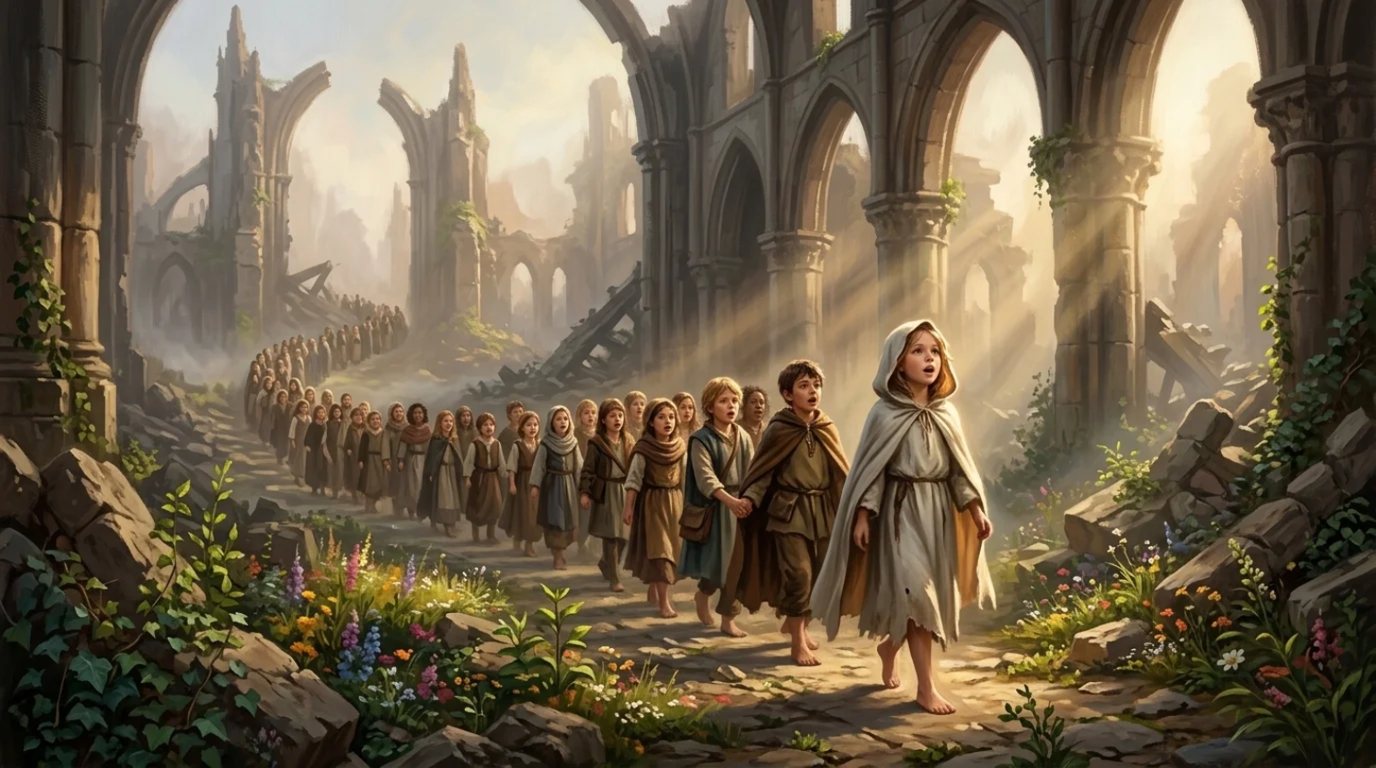
Jahr 100. Aus den Ruinen am Rand der Stadt kommt eines Morgens ein Mädchen. Niemand kennt sie, sie hat keinen Herrn, keine Familie und keinen Namen, den sie nennen will. Sie setzt sich auf die Stufen des Brunnens und singt ein Lied, das so einfach ist, dass man es nach einmal Hören kennt: von einem Morgen nach dem Krieg, von Schwertern, die zu Pflügen werden, von einem Thron, auf dem niemand sitzt.

Am Abend singen es die Kinder der Nachbarschaft. Nach einer Woche singen es die Kinder der ganzen Stadt. Händler tragen es in die nächsten Täler, Hirten auf die Berge, Fischer übers Meer. Bald gibt es keinen Ort mehr, an dem die Kinder es nicht kennen.

Die Erwachsenen merken es kaum. Sie arbeiten, sie bauen, sie handeln. Aber die Kinder erzählen sich mit dem Lied eine Geschichte, die ihre Eltern zu erzählen verlernt haben – die Geschichte davon, warum man einmal geschworen hat. Das Mädchen verschwindet so still, wie es gekommen ist. Ihr Lied bleibt. Und es wird wiederkehren, viel später, am Ende einer ganz anderen Welt.

AD 100. One morning a girl comes out of the ruins at the edge of the city. No one knows her; she has no master, no family, and no name she is willing to give. She sits down on the steps of the well and sings a song so simple that you know it after hearing it once: of a morning after the war, of swords that become ploughs, of a throne on which no one sits.

By evening the children of the neighbourhood are singing it. Within a week the children of the whole city are singing it. Merchants carry it into the next valleys, shepherds up into the mountains, fishermen across the sea. Soon there is no place left where the children do not know it.

The grown-ups hardly notice. They work, they build, they trade. But with the song the children tell one another a story their parents have forgotten how to tell – the story of why an oath was once sworn. The girl disappears as quietly as she came. Her song remains. And it will return, much later, at the end of an entirely different world.

100 год. Однажды утром из руин на окраине города выходит девочка. Никто её не знает, у неё нет ни господина, ни семьи, ни имени, которое она захотела бы назвать. Она садится на ступени у колодца и поёт песню, такую простую, что её запоминают с первого раза: об утре после войны, о мечах, ставших плугами, о троне, на котором никто не сидит.

К вечеру её поют соседские дети. Через неделю – дети всего города. Торговцы уносят её в соседние долины, пастухи – в горы, рыбаки – за море. Вскоре не остаётся места, где дети не знали бы её.

Взрослые почти не замечают этого. Они работают, строят, торгуют. Но дети рассказывают друг другу песней историю, которую их родители разучились рассказывать, – историю о том, зачем когда-то давали клятву. Девочка исчезает так же тихо, как появилась. Её песня остаётся. И она вернётся – много позже, в конце совсем другого мира.

Año 100. Una mañana, de las ruinas a las afueras de la ciudad sale una muchacha. Nadie la conoce; no tiene señor, ni familia, ni nombre que quiera decir. Se sienta en los escalones de la fuente y canta una canción tan sencilla que basta oírla una vez para saberla: habla de una mañana después de la guerra, de espadas que se vuelven arados, de un trono en el que nadie se sienta.

Al anochecer la cantan los niños del vecindario. Al cabo de una semana la cantan los niños de toda la ciudad. Los mercaderes la llevan a los valles vecinos, los pastores a los montes, los pescadores más allá del mar. Pronto no queda lugar donde los niños no la conozcan.

Los adultos apenas lo notan. Trabajan, construyen, comercian. Pero con la canción, los niños se cuentan una historia que sus padres han desaprendido a contar: la historia de por qué un día se juró. La muchacha desaparece tan calladamente como vino. Su canción permanece. Y volverá, mucho después, al final de un mundo muy distinto.

Song anhörenListen to the songСлушать песнюEscuchar la canción →
I.05 · Jahr 500AD 500500 годaño 500

A Thousand Years

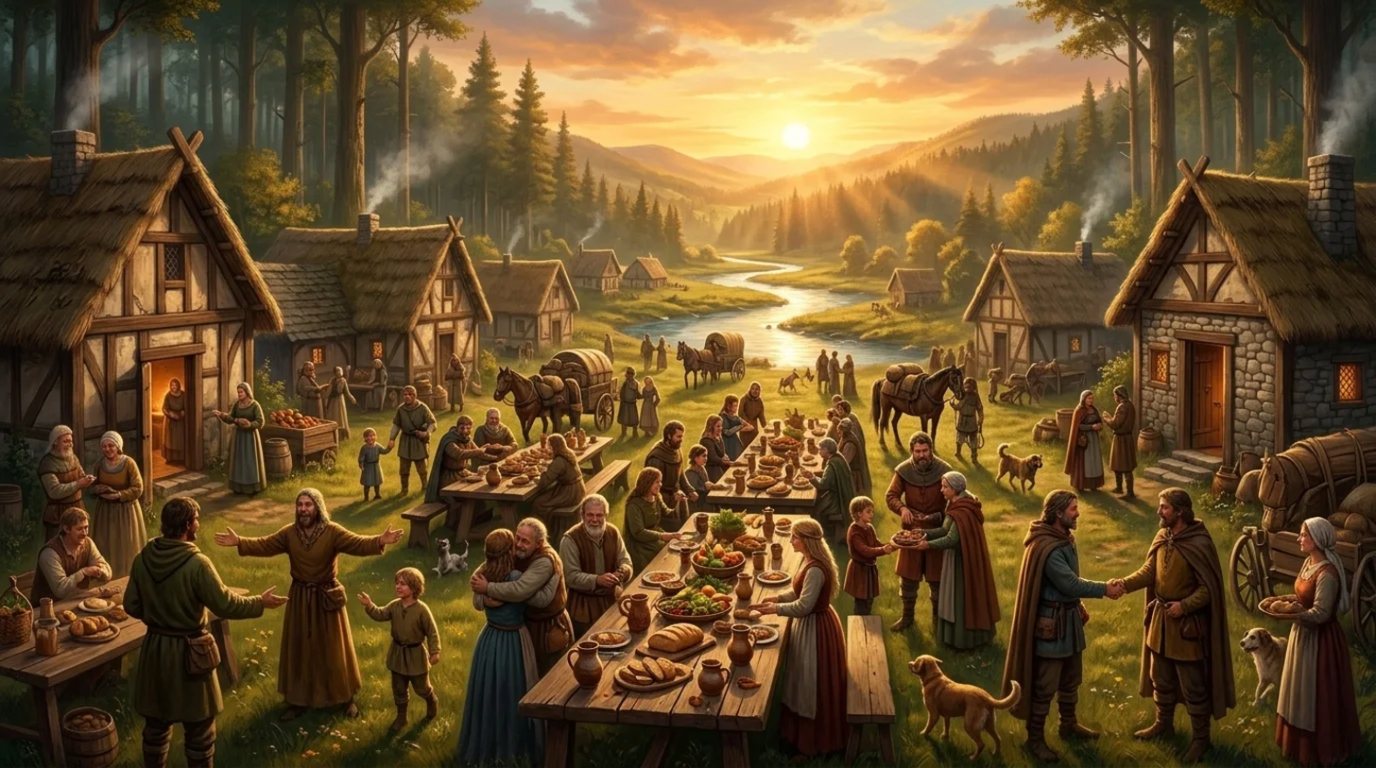
Jahr 500. Fünf Jahrhunderte nach dem Schwur sieht die Welt aus, wie man sie sich nur in Träumen vorgestellt hatte. Auf jedem Tisch liegt Brot. Die Türen der Häuser stehen offen, weil niemand etwas stiehlt, was er teilen kann. Die Flüsse sind so klar, dass man die Steine am Grund zählen kann.

Es ist kein Paradies aus Gold. Es ist mit bloßen Händen gebaut, Stein für Stein, Ernte für Ernte. Die Menschen streiten, sie irren, sie versöhnen sich wieder. Aber niemand herrscht, und deshalb muss sich niemand ducken.

An den Festtagen versammeln sich die Dörfer auf den großen Wiesen. Gospelchöre aus dem Süden und Opernchöre aus den Städten singen gemeinsam, und dazwischen singt immer irgendwo ein Kind das alte Lied vom Brunnen. Es ist genug für alle da, singen sie, und es ist wahr. Die Alten erzählen den Jungen vom Krieg, aber die Jungen glauben es nur halb. Wie sollte jemand je wieder Mauern bauen wollen, wenn die offenen Türen so gut funktionieren? Der Frieden ist so selbstverständlich geworden wie das Wetter. Gerade das macht ihn verletzlich.

AD 500. Five centuries after the oath, the world looks the way people had only ever imagined it in dreams. There is bread on every table. The doors of the houses stand open, because no one steals what he can share. The rivers are so clear that you can count the stones on their beds.

It is not a paradise of gold. It has been built with bare hands, stone by stone, harvest by harvest. People quarrel, they err, they make their peace again. But no one rules, and so no one has to cower.

On feast days the villages gather on the great meadows. Gospel choirs from the south and opera choirs from the cities sing together, and somewhere in between, always, a child is singing the old song of the well. There is enough for everyone, they sing, and it is true. The old tell the young about the war, but the young only half believe it. Why would anyone ever want to build walls again, when open doors work so well? Peace has become as much a matter of course as the weather. That is precisely what makes it vulnerable.

500 год. Пять столетий спустя после клятвы мир выглядит так, как его прежде видели лишь во сне. На каждом столе – хлеб. Двери домов открыты, потому что никто не крадёт того, чем можно поделиться. Реки так прозрачны, что камни на дне можно пересчитать.

Это не рай из золота. Он построен голыми руками, камень за камнем, урожай за урожаем. Люди спорят, ошибаются, снова мирятся. Но никто не властвует, и поэтому никому не нужно пригибаться.

В праздничные дни деревни собираются на больших лугах. Госпел-хоры с юга и оперные хоры из городов поют вместе, и среди них всегда где-нибудь ребёнок поёт старую песню у колодца. «Хватит на всех», – поют они, и это правда. Старики рассказывают молодым о войне, но молодые верят лишь наполовину. Кому придёт в голову снова строить стены, когда открытые двери так хорошо себя оправдывают? Мир стал таким же само собой разумеющимся, как погода. Именно это и делает его уязвимым.

Año 500. Cinco siglos después del juramento, el mundo tiene el aspecto que solo en sueños se había imaginado. En cada mesa hay pan. Las puertas de las casas permanecen abiertas, porque nadie roba lo que puede compartir. Los ríos son tan transparentes que pueden contarse las piedras del fondo.

No es un paraíso de oro. Está construido con las manos desnudas, piedra a piedra, cosecha a cosecha. Los hombres discuten, se equivocan, vuelven a reconciliarse. Pero nadie reina, y por eso nadie tiene que agachar la cabeza.

En los días de fiesta, las aldeas se reúnen en las grandes praderas. Coros de góspel del sur y coros de ópera de las ciudades cantan juntos, y entre ellos siempre hay, en algún lugar, un niño que canta la vieja canción de la fuente. «Hay suficiente para todos», cantan, y es verdad. Los ancianos cuentan a los jóvenes historias de la guerra, pero los jóvenes solo las creen a medias. ¿Cómo podría alguien querer volver a levantar muros, si las puertas abiertas funcionan tan bien? La paz se ha vuelto tan natural como el tiempo que hace. Precisamente eso la vuelve vulnerable.

Song anhörenListen to the songСлушать песнюEscuchar la canción →
I.06 · Jahr 700AD 700700 годaño 700

Garden in the Ruins

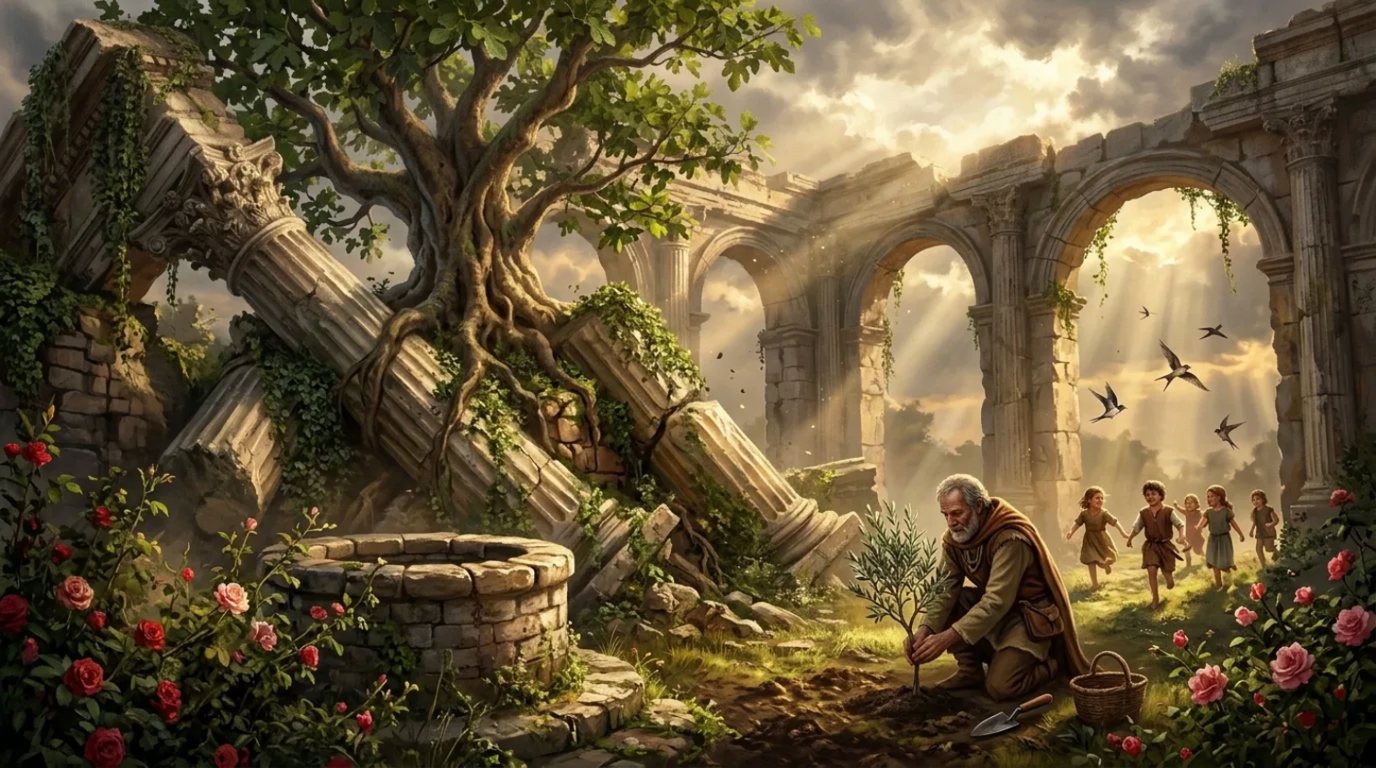
Jahr 700. Im Tempel der alten Götter, den seit Jahrhunderten niemand mehr betritt, bricht ein Feigenbaum durch die Steinplatten. Seine Wurzeln sprengen die Altäre, seine Äste wachsen durch die Säulen, und im Sommer fallen reife Feigen auf die Stufen, auf denen früher Opfer dargebracht wurden.

Überall geschieht dasselbe. In der Arena, in der einst Menschen um ihr Leben kämpften, weiden Schafe. Am alten Galgen auf dem Hügel rankt wilder Wein, und im Herbst ernten die Kinder dort Trauben. Die Helme der Legionen, längst eingeschmolzen, sind zu Schalen geworden, aus denen man Brot isst.

Am Rand eines Feldes pflanzt ein alter Mann einen Olivenbaum. Er ist über achtzig, seine Hände zittern, und er weiß genau, dass ein Olivenbaum zwanzig Jahre braucht, bis er trägt. Ein Junge fragt ihn, warum er das tut. Der Alte klopft die Erde fest, gießt Wasser darüber und lächelt: Nicht für mich. Für die, die nach mir kommen. So ist diese Welt gebaut worden, und so wird sie gehalten – von Menschen, die Bäume pflanzen, in deren Schatten sie nie sitzen werden.

AD 700. In the temple of the old gods, where no one has set foot for centuries, a fig tree breaks through the paving stones. Its roots split the altars, its branches grow through the columns, and in summer ripe figs fall onto the steps where sacrifices were once offered.

Everywhere the same thing is happening. In the arena where men once fought for their lives, sheep are grazing. Wild vines climb the old gallows on the hill, and in autumn the children gather grapes there. The helmets of the legions, long since melted down, have become bowls from which people eat their bread.

At the edge of a field an old man is planting an olive tree. He is past eighty, his hands tremble, and he knows full well that an olive tree takes twenty years to bear fruit. A boy asks him why he is doing it. The old man presses the earth down firmly, pours water over it, and smiles: Not for me. For those who come after me. That is how this world was built, and that is how it is kept – by people who plant trees in whose shade they will never sit.

700 год. В храме старых богов, куда уже много веков никто не входит, сквозь каменные плиты пробивается смоковница. Её корни разламывают алтари, её ветви прорастают сквозь колонны, и летом спелые смоквы падают на ступени, где некогда приносили жертвы.

Повсюду происходит то же самое. На арене, где когда-то люди бились за свою жизнь, пасутся овцы. Старую виселицу на холме оплёл дикий виноград, и осенью дети собирают там гроздья. Шлемы легионов, давно переплавленные, стали чашами, из которых едят хлеб.

На краю поля старик сажает оливу. Ему за восемьдесят, руки его дрожат, и он хорошо знает, что олива приносит плоды лишь через двадцать лет. Мальчик спрашивает, зачем он это делает. Старик прихлопывает землю, поливает её и улыбается: «Не для себя. Для тех, кто придёт после меня». Так был построен этот мир, и так он держится – людьми, которые сажают деревья, в тени которых им никогда не сидеть.

Año 700. En el templo de los antiguos dioses, donde nadie entra desde hace siglos, una higuera rompe las losas de piedra. Sus raíces revientan los altares, sus ramas crecen a través de las columnas, y en verano caen higos maduros sobre los escalones donde antaño se ofrecían sacrificios.

En todas partes ocurre lo mismo. En la arena donde un día los hombres luchaban por su vida, pastan ovejas. En la vieja horca de la colina trepa la vid silvestre, y en otoño los niños vendimian allí las uvas. Los yelmos de las legiones, fundidos hace mucho, se han convertido en cuencos en los que se come el pan.

Al borde de un campo, un anciano planta un olivo. Pasa de los ochenta, le tiemblan las manos, y sabe muy bien que un olivo tarda veinte años en dar fruto. Un muchacho le pregunta por qué lo hace. El anciano apisona la tierra, la riega y sonríe: «No es para mí. Es para los que vendrán después». Así se ha construido este mundo, y así se sostiene: por gente que planta árboles a cuya sombra nunca se sentará.

Song anhörenListen to the songСлушать песнюEscuchar la canción →
I.07 · Jahr 1000AD 10001000 годaño 1000

The Serpent Sleeps

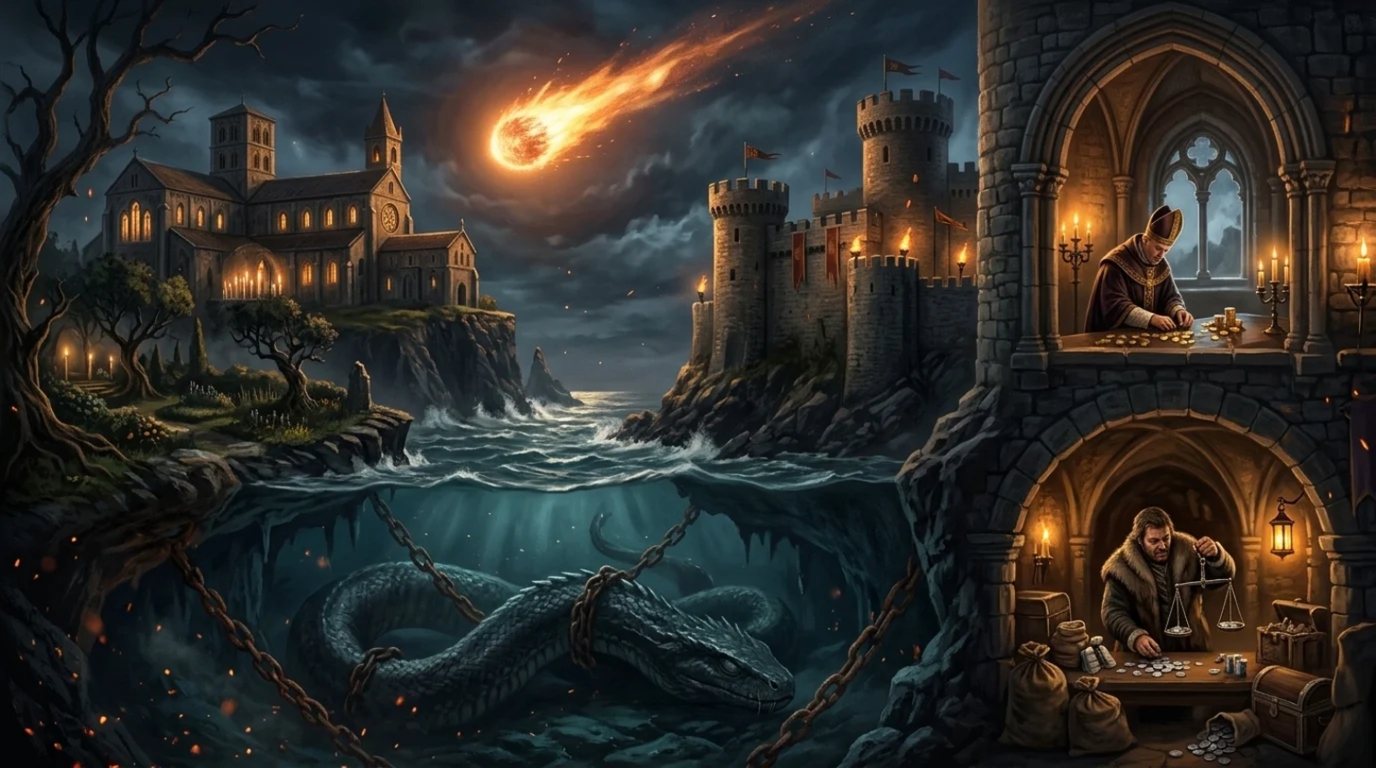
Jahr 1000. Ein Komet steht wochenlang am Himmel, und zum ersten Mal seit Generationen haben die Menschen Angst. In den Klöstern zählen Mönche die Kerzen und rechnen das Ende der Welt aus. Prediger ziehen durch die Dörfer und verkaufen Gewissheit. Und ein Bischof kauft eine Burg – nur zur Sicherheit, sagt er, nur für den Fall der Fälle.

Es ist eine Kleinigkeit. Ein Turm, eine Mauer, ein Tor, das man schließen kann. Aber zum ersten Mal seit tausend Jahren gehört etwas einem einzelnen Menschen, das die anderen nicht betreten dürfen.

Tief unter dem Paradies, unter den Gärten und Feldern und Brunnen, liegt etwas, das man vor tausend Jahren in Ketten gelegt hat. Niemand erinnert sich mehr daran. Die Ketten sind alt geworden, der Rost frisst die Glieder, und in der Dunkelheit hebt und senkt sich langsam ein schuppiger Leib. Die Schlange schläft noch. Aber sie atmet. Und jedes Mal, wenn oben jemand ein Tor schließt, eine Mauer baut oder eine Krone poliert, atmet sie ein wenig tiefer.

The year 1000. For weeks a comet hangs in the sky, and for the first time in generations people are afraid. In the monasteries monks count the candles and calculate the end of the world. Preachers travel from village to village selling certainty. And a bishop buys a castle – just to be safe, he says, just in case.

It is a small thing. A tower, a wall, a gate that can be shut. But for the first time in a thousand years something belongs to a single man that the others may not enter.

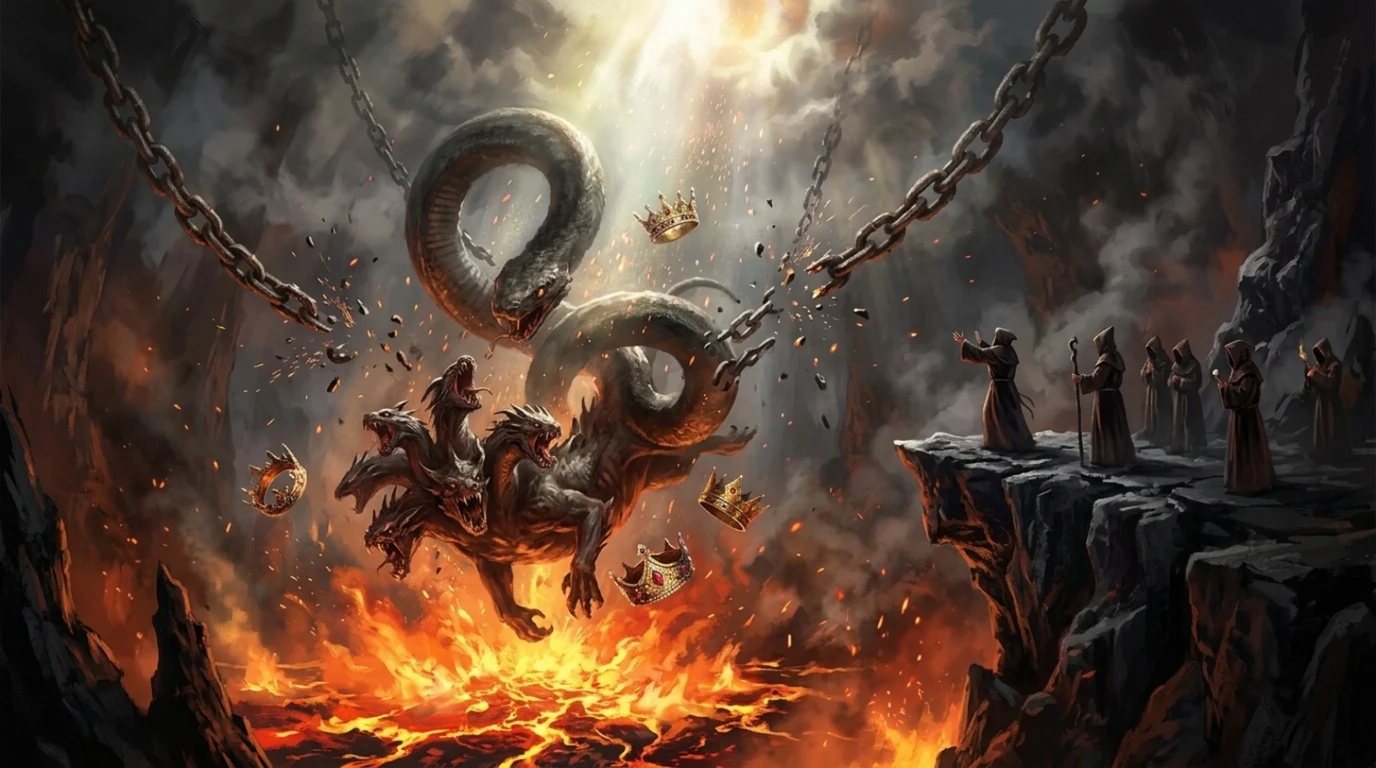
Deep beneath paradise, beneath the gardens and fields and wells, lies something that was put in chains a thousand years ago. No one remembers it anymore. The chains have grown old, rust is eating the links, and in the darkness a scaled body slowly rises and falls. The serpent is still asleep. But it is breathing. And every time someone above shuts a gate, builds a wall, or polishes a crown, it breathes a little deeper.

1000 год. Неделями в небе стоит комета, и впервые за многие поколения людям страшно. В монастырях монахи считают свечи и высчитывают конец света. По деревням ходят проповедники и продают уверенность. А один епископ покупает замок – только на всякий случай, говорит он, только ради надёжности.

Это мелочь. Башня, стена, ворота, которые можно запереть. Но впервые за тысячу лет что-то принадлежит одному человеку, и другим туда входить нельзя.

Глубоко под раем, под садами, полями и колодцами, лежит то, что тысячу лет назад заковали в цепи. Никто больше этого не помнит. Цепи состарились, ржавчина разъедает звенья, и во тьме медленно поднимается и опускается чешуйчатое тело. Змей ещё спит. Но он дышит. И всякий раз, когда наверху кто-то запирает ворота, возводит стену или начищает корону, он вдыхает чуть глубже.

Año 1000. Un cometa permanece semanas en el cielo, y por primera vez en generaciones los hombres tienen miedo. En los monasterios, los monjes cuentan las velas y calculan el fin del mundo. Los predicadores recorren las aldeas vendiendo certezas. Y un obispo compra un castillo: solo por seguridad, dice, solo por si acaso.

Es una nimiedad. Una torre, una muralla, una puerta que puede cerrarse. Pero por primera vez en mil años algo pertenece a un solo hombre, y los demás no pueden entrar en ello.

En lo hondo, bajo el paraíso, bajo los jardines y los campos y las fuentes, yace algo que hace mil años fue atado con cadenas. Ya nadie lo recuerda. Las cadenas han envejecido, el óxido roe los eslabones, y en la oscuridad un cuerpo escamoso se alza y desciende lentamente. La serpiente todavía duerme. Pero respira. Y cada vez que arriba alguien cierra una puerta, levanta un muro o pule una corona, respira un poco más hondo.

Song anhörenListen to the songСлушать песнюEscuchar la canción →
I.08 · Jahr 1076AD 10761076 годaño 1076

Heaven on Earth

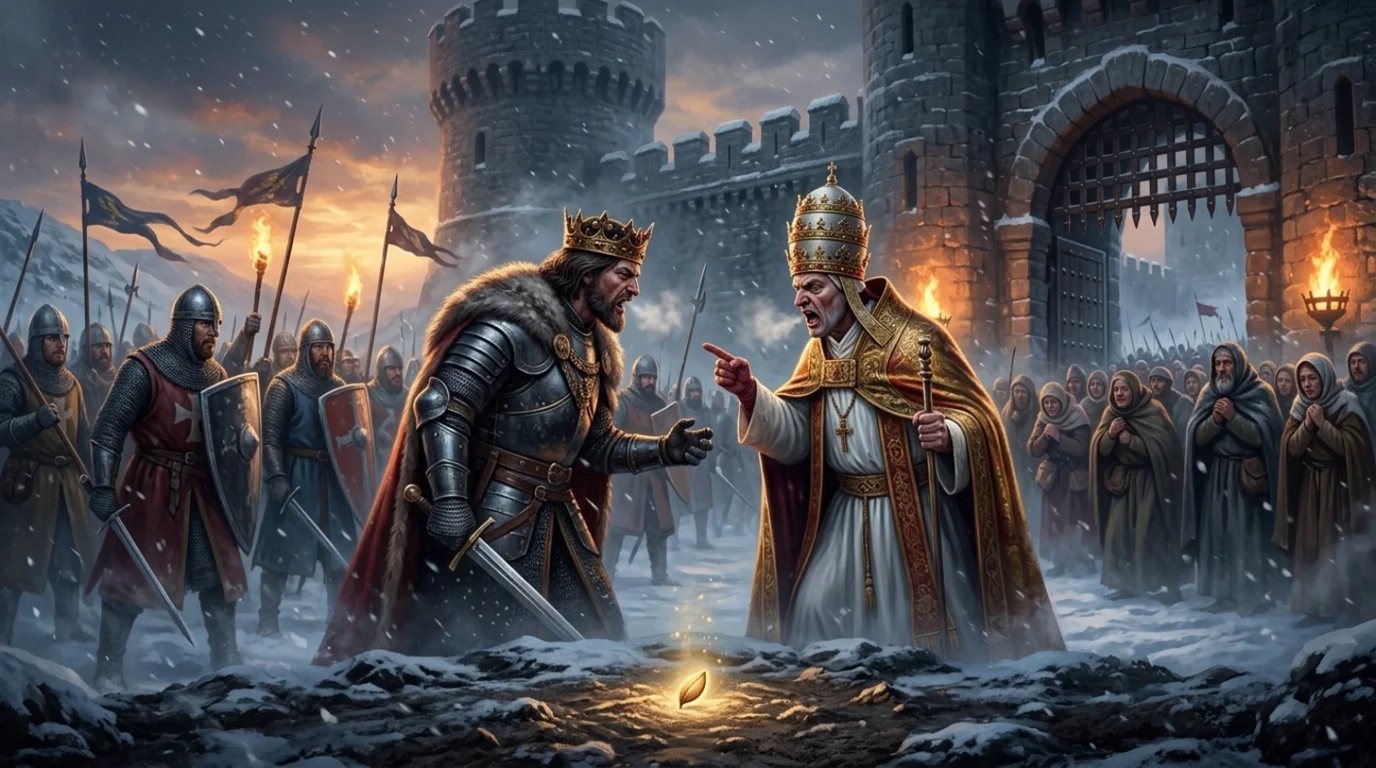
Winter 1076. Ein Kaiser steht barfuß im Schnee vor einer Burg und wartet drei Tage lang auf die Vergebung eines Papstes. Es geht um die Frage, wer Bischöfe einsetzen darf, wer über wen bestimmt, wem der Himmel gehört. Kaiser und Papst reißen an ihm wie zwei Hunde an einem Tuch.

Überall im Land kehren die Könige zurück. Sie nennen sich Schutzherren, Hüter, Väter des Volkes. Sie bauen Mauern um die Städte und Zollschranken an die Brücken. Die Türen, die tausend Jahre offen standen, bekommen Schlösser. Die Menschen lassen es geschehen, weil jeder Schritt so klein ist, so vernünftig, so gut gemeint.

Das Tausendjährige Reich des Friedens endet nicht mit einem Krieg, sondern mit einer langsamen Gewöhnung. Und doch ist nicht alles verloren. Irgendwo in einem verschneiten Dorf summt eine Großmutter ihrem Enkel das alte Lied vom Brunnen vor, und der Junge summt es mit. Das Lied der Kinder schläft in der Erde wie ein Samen im Winter. Es wartet. Und unten, in der Tiefe, öffnet die Schlange zum ersten Mal die Augen.

Winter 1076. An emperor stands barefoot in the snow before a castle and waits three days for a pope’s forgiveness. The question is who may appoint bishops, who decides over whom, to whom heaven belongs. Emperor and pope tear at it like two dogs at a cloth.

All across the land the kings are returning. They call themselves protectors, guardians, fathers of the people. They build walls around the cities and toll gates on the bridges. The doors that stood open for a thousand years are fitted with locks. People let it happen, because every step is so small, so reasonable, so well meant.

The thousand-year kingdom of peace does not end with a war, but with a slow growing-used-to. And yet not everything is lost. Somewhere in a snowbound village a grandmother hums the old song of the well to her grandson, and the boy hums along. The children’s song sleeps in the earth like a seed in winter. It waits. And down below, in the depths, the serpent opens its eyes for the first time.

Зима 1076 года. Император стоит босой в снегу перед замком и три дня ждёт прощения от папы. Речь идёт о том, кому ставить епископов, кто над кем властен, кому принадлежит небо. Император и папа рвут его друг у друга, как две собаки – тряпку.

По всей стране возвращаются короли. Они называют себя покровителями, хранителями, отцами народа. Они обносят города стенами и ставят заставы на мостах. Двери, тысячу лет стоявшие открытыми, обзаводятся замками. Люди позволяют этому случиться, потому что каждый шаг так мал, так разумен, так благонамерен.

Тысячелетнее царство мира кончается не войной, а медленной привычкой. И всё же не всё потеряно. Где-то в заснеженной деревне бабушка напевает внуку старую песню у колодца, и мальчик подпевает ей. Песня детей спит в земле, как семя зимой. Она ждёт. А внизу, в глубине, Змей впервые открывает глаза.

Invierno de 1076. Un emperador aguarda descalzo en la nieve, ante un castillo, durante tres días, el perdón de un papa. Se trata de saber quién puede investir a los obispos, quién decide sobre quién, a quién pertenece el cielo. Emperador y papa tiran de él como dos perros de un mismo paño.

Por todo el país regresan los reyes. Se hacen llamar protectores, custodios, padres del pueblo. Levantan murallas en torno a las ciudades y barreras de peaje en los puentes. Las puertas que durante mil años estuvieron abiertas reciben cerrojos. La gente lo deja pasar, porque cada paso es tan pequeño, tan razonable, tan bienintencionado.

El reino milenario de la paz no termina con una guerra, sino con una lenta costumbre. Y sin embargo, no todo está perdido. En algún lugar, en una aldea cubierta de nieve, una abuela le tararea a su nieto la vieja canción de la fuente, y el niño la tararea con ella. La canción de los niños duerme en la tierra como una semilla en invierno. Espera. Y abajo, en lo profundo, la serpiente abre los ojos por primera vez.

Song anhörenListen to the songСлушать песнюEscuchar la canción →
TeilPartЧастьParte II · Die kleine Zeit · heuteThe little season · todayМалое время · сегодняEl breve tiempo · hoy

End of Satanic World

Teil II der Geschichte · Die GegenwartPart II of the story · The presentЧасть II истории · НастоящееParte II de la historia · El presente

Der zweite Teil ist die Gegenwart. Die Kronen sind zurückgekehrt, nur tragen sie heute andere Namen: Märkte, Plattformen, Systeme, Sicherheit. Die Schlange ist erwacht und verkauft den Himmel stundenweise. Ein Mann, der alles verloren hat, weigert sich zu knien und beginnt zu singen – und aus seiner einen Stimme werden Millionen. Sie stürmen gläserne Himmel, sie erleben den großen Neustart, sie hören die Toten flüstern. Und sie sehen zu, wie aus einem Niemand ein Herrscher wird, wie aus einer neuen Welt eine eiserne wird, wie alte Männer Schach mit jungen Leben spielen. Am Ende stehen zwei Heere im Dunkeln. Gog gegen Magog. Und niemand gewinnt.

The second part is the present. The crowns have returned; they simply go by other names now: markets, platforms, systems, security. The serpent has woken and sells heaven by the hour. A man who has lost everything refuses to kneel and begins to sing – and his one voice becomes millions. They storm heavens of glass, they live through the great reset, they hear the dead whisper. And they watch as a nobody becomes a ruler, as a new world becomes an iron one, as old men play chess with young lives. At the end two armies stand in the dark. Gog against Magog. And no one wins.

Вторая часть – это наше время. Короны вернулись, только теперь у них другие имена: рынки, платформы, системы, безопасность. Змей пробудился и продаёт небо почасово. Человек, потерявший всё, отказывается преклонить колени и начинает петь – и его единственный голос становится голосом миллионов. Они штурмуют стеклянные небеса, переживают великую перезагрузку, слышат шёпот мёртвых. И смотрят, как никто становится властелином, как новый мир становится железным, как старики играют в шахматы молодыми жизнями. В конце во тьме стоят два войска. Гог против Магога. И никто не побеждает.

La segunda parte es el presente. Las coronas han vuelto, solo que hoy llevan otros nombres: mercados, plataformas, sistemas, seguridad. La serpiente ha despertado y vende el cielo por horas. Un hombre que lo ha perdido todo se niega a arrodillarse y empieza a cantar, y de su única voz nacen millones. Asaltan cielos de cristal, viven el gran reinicio, oyen susurrar a los muertos. Y ven cómo un don nadie se convierte en soberano, cómo un mundo nuevo se vuelve de hierro, cómo unos ancianos juegan al ajedrez con vidas jóvenes. Al final, dos ejércitos se enfrentan en la oscuridad. Gog contra Magog. Y nadie gana.

II.01 · heutetodayсегодняhoy

Satanic World

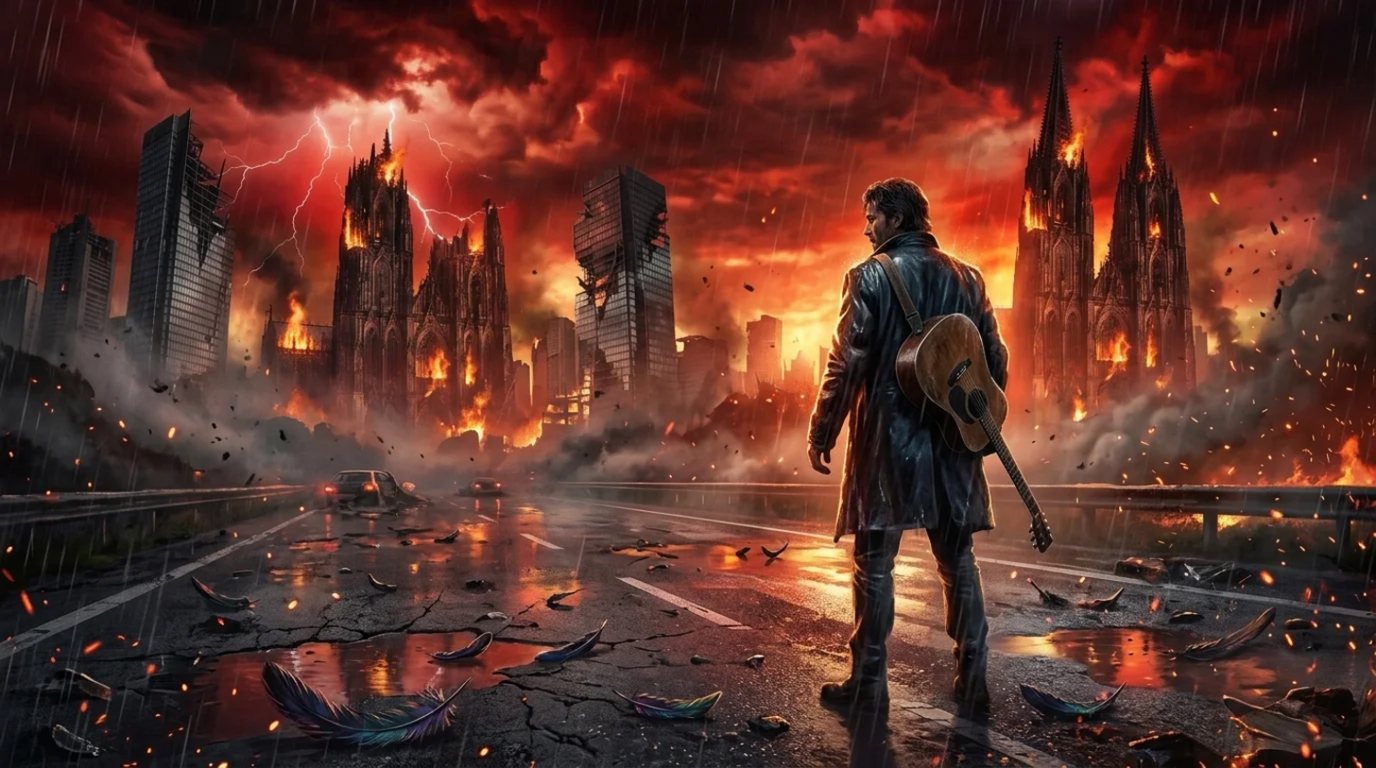
Heute. Eine Straße am Rand einer großen Stadt, nachts, im Regen. Ein Mann sitzt an einem verstimmten Klavier in einer Bar, die längst geschlossen hat. Er hat alles verloren, was man verlieren kann: die Arbeit, das Haus, die Familie, den Glauben an die Versprechen der Werbetafeln, die draußen in Endlosschleife leuchten. Er hat tausend Schlachten verloren und keine einzige gewonnen.

Trotzdem singt er. Erst leise, nur für sich, dann lauter. Er singt von einer Welt, in der die Engel ihre Flügel verkaufen, in der die Wahrheit ein Preisschild trägt und die Lüge eine Werbeagentur hat. Er singt von der Schlange, die erwacht ist und die Kronen zurückgebracht hat – nur heißen sie jetzt anders.

Und mitten im Lied schlägt er den Deckel des Klaviers zu, steht auf und schreit es in die Nacht: Ich werde nie wieder knien. Die Gitarren setzen ein wie ein Gewitter. Draußen bleiben Menschen im Regen stehen. Einer zieht sein Telefon, filmt, schickt es weiter. Am Morgen haben es Millionen gesehen. Die satanische Welt hat einen Gegner bekommen, und er besitzt nichts außer seiner Stimme.

Today. A street at the edge of a great city, at night, in the rain. A man sits at an out-of-tune piano in a bar that closed long ago. He has lost everything a person can lose: his work, his house, his family, his faith in the promises of the billboards glowing outside in an endless loop. He has lost a thousand battles and never won a single one.

And still he sings. Softly at first, only for himself, then louder. He sings of a world in which the angels sell their wings, in which truth wears a price tag and the lie has an advertising agency. He sings of the serpent that has woken and brought the crowns back – only now they go by other names.

And in the middle of the song he slams the lid of the piano shut, stands up and shouts it into the night: I will never kneel again. The guitars come in like a thunderstorm. Outside, people stop in the rain. One of them pulls out his phone, films it, sends it on. By morning millions have seen it. The satanic world has found an adversary, and he owns nothing but his voice.

Сегодня. Улица на окраине большого города, ночь, дождь. Человек сидит за расстроенным пианино в баре, который давно закрылся. Он потерял всё, что можно потерять: работу, дом, семью, веру в обещания рекламных щитов, что светятся снаружи по бесконечному кругу. Он проиграл тысячу сражений и не выиграл ни одного.

И всё же он поёт. Сперва тихо, только для себя, потом громче. Он поёт о мире, где ангелы продают свои крылья, где у правды есть ценник, а у лжи – рекламное агентство. Он поёт о Змее, который пробудился и вернул короны, – только зовутся они теперь иначе.

И посреди песни он захлопывает крышку пианино, встаёт и кричит в ночь: «Я никогда больше не встану на колени». Гитары врываются, как гроза. Снаружи люди останавливаются под дождём. Кто-то достаёт телефон, снимает, пересылает дальше. К утру это видят миллионы. У сатанинского мира появился противник, и у него нет ничего, кроме голоса.

Hoy. Una calle en las afueras de una gran ciudad, de noche, bajo la lluvia. Un hombre está sentado ante un piano desafinado en un bar que cerró hace tiempo. Ha perdido todo lo que se puede perder: el trabajo, la casa, la familia, la fe en las promesas de las vallas publicitarias que brillan afuera en un bucle sin fin. Ha perdido mil batallas y no ha ganado ni una sola.

Aun así, canta. Primero en voz baja, solo para sí, luego más alto. Canta sobre un mundo en el que los ángeles venden sus alas, en el que la verdad lleva etiqueta de precio y la mentira tiene agencia de publicidad. Canta sobre la serpiente que ha despertado y ha traído de vuelta las coronas, solo que ahora se llaman de otro modo.

Y en mitad de la canción cierra de golpe la tapa del piano, se levanta y lo grita a la noche: «Nunca más me arrodillaré». Las guitarras irrumpen como una tormenta. Afuera, la gente se detiene bajo la lluvia. Alguien saca el teléfono, graba, lo reenvía. Por la mañana lo han visto millones. El mundo satánico ha encontrado un adversario, y este no posee nada más que su voz.

Song anhörenListen to the songСлушать песнюEscuchar la canción →
II.02 · heutetodayсегодняhoy

Rising Up

Sie haben den Mann an dem Klavier gehört, in den Kellern, in den Wohnheimen, in den Schichten der Nacht. Die stillen Millionen – Bäcker, Pflegerinnen, Soldaten, Mütter mit Kindern auf dem Arm. Man hat sie ihr Leben lang mit Lügen auf silbernen Löffeln gefüttert: Es geht nicht anders. Es war schon immer so. Ihr seid zu wenige.

Jetzt steigen sie die Treppen herauf. Erst stampft einer mit dem Fuß, dann klatscht eine in die Hände, dann tun es hundert, dann tausend. Ihr Gesang beginnt ohne Instrumente, nur Stimmen und Schritte, und wächst Takt für Takt, bis die ganze Band einsetzt und die Straßen beben.

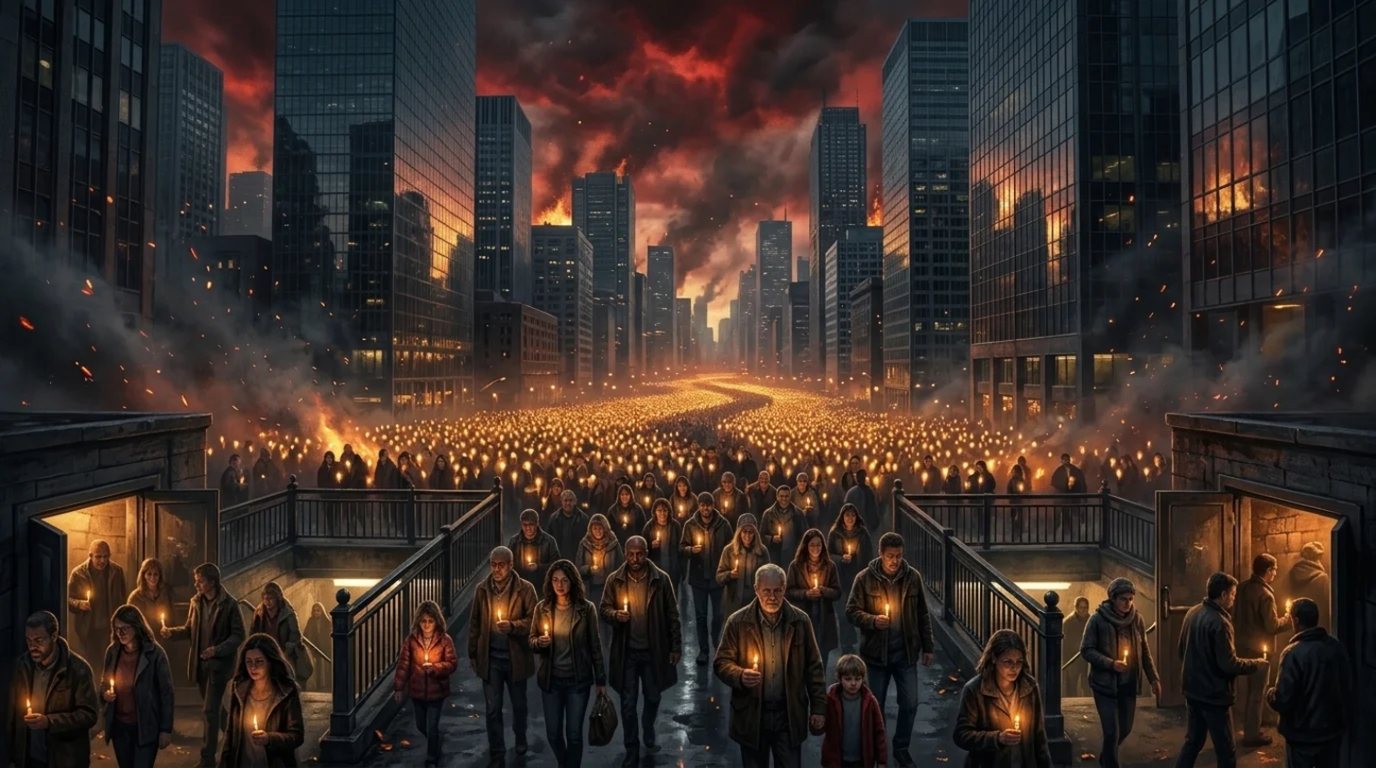
Niemand führt sie an. Sie haben kein Programm, keine Partei, keine Fahne. Sie haben nur eine Erkenntnis, die sich wie ein Feuer ausbreitet: Jede Kerze, die man im Dunkeln anzündet, wird zur Sonne, wenn genug Menschen ihre Kerzen daneben halten. Aus der Asche, sagen sie, steigen wir auf. Und zum ersten Mal seit langer Zeit sehen die Mächtigen von ihren Balkonen herab und wissen nicht, was sie sagen sollen.

They have heard the man at the piano – in the basements, in the hostels, on the night shifts. The silent millions: bakers, nurses, soldiers, mothers with children on their arms. All their lives they have been fed lies on silver spoons: There is no other way. It has always been like this. There are too few of you.

Now they are climbing the stairs. First one stamps his foot, then one claps her hands, then a hundred do it, then a thousand. Their song begins without instruments, only voices and footsteps, and grows beat by beat until the whole band comes in and the streets shake.

No one leads them. They have no programme, no party, no flag. They have only one realisation, spreading like fire: every candle lit in the dark becomes a sun when enough people hold their candles beside it. From the ashes, they say, we rise. And for the first time in a long while the powerful look down from their balconies and do not know what to say.

Они слышали человека за пианино – в подвалах, в общежитиях, в ночных сменах. Безмолвные миллионы – пекари, медсёстры, солдаты, матери с детьми на руках. Всю жизнь их кормили ложью с серебряной ложечки: «Иначе нельзя. Так было всегда. Вас слишком мало».

Теперь они поднимаются по лестницам. Сначала один топает ногой, потом одна хлопает в ладоши, потом сто, потом тысяча. Их пение начинается без инструментов, одни голоса и шаги, и растёт такт за тактом, пока не вступает вся группа и не начинают дрожать улицы.

Никто их не ведёт. У них нет ни программы, ни партии, ни знамени. У них есть лишь одно прозрение, которое распространяется, как пожар: каждая свеча, зажжённая во тьме, становится солнцем, если достаточно людей поднесут к ней свои свечи. «Из пепла, – говорят они, – мы восстанем». И впервые за долгое время сильные мира смотрят вниз со своих балконов и не знают, что сказать.

Han oído al hombre del piano, en los sótanos, en los albergues, en los turnos de la noche. Los millones silenciosos: panaderos, enfermeras, soldados, madres con niños en brazos. Toda la vida los han alimentado con mentiras en cucharas de plata: «No hay otra manera. Siempre ha sido así. Son demasiado pocos».

Ahora suben las escaleras. Primero uno golpea el suelo con el pie, luego una bate palmas, luego lo hacen cien, luego mil. Su canto empieza sin instrumentos, solo voces y pasos, y crece compás a compás, hasta que entra la banda entera y las calles tiemblan.

Nadie los encabeza. No tienen programa, ni partido, ni bandera. Solo tienen una certeza que se propaga como un incendio: cada vela que se enciende en la oscuridad se vuelve sol cuando suficientes personas acercan la suya. «De las cenizas», dicen, «nos levantamos». Y por primera vez en mucho tiempo, los poderosos miran desde sus balcones y no saben qué decir.

Song anhörenListen to the songСлушать песнюEscuchar la canción →
II.03 · heutetodayсегодняhoy

Destroy Their Heaven

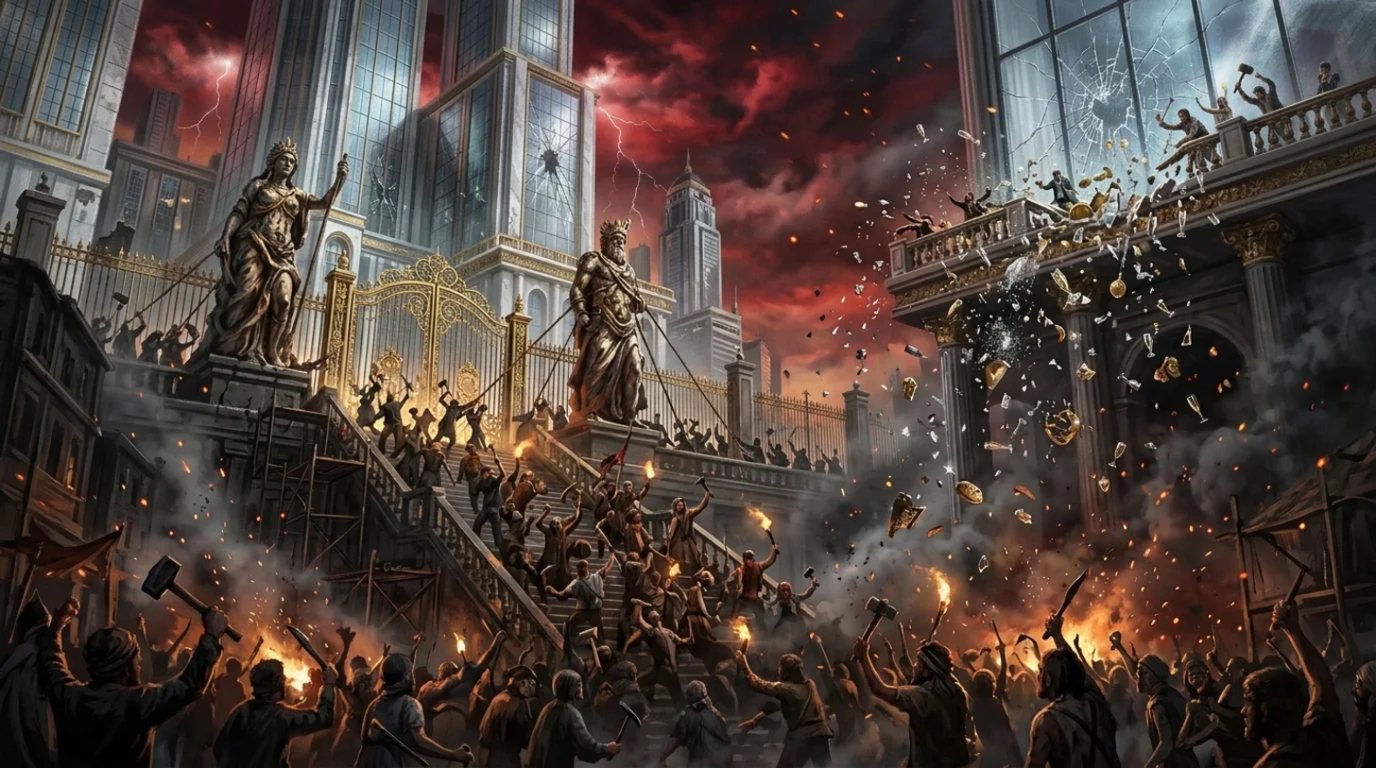
Über den hungrigen Straßen der Stadt schwebt ein zweiter Himmel. Er ist aus Glas gebaut, getragen von Türmen, die bis in die Wolken reichen, und in ihm leben die, die alles haben. Marmorne Götter stehen in ihren Gärten. Goldene Tore öffnen sich nur für den, der den richtigen Code kennt. Der Champagner fließt, während unten die Kinder Wasser aus Pfützen trinken.

Die Bewohner des gläsernen Himmels glauben, sie hätten sich ihr Paradies verdient. Sie glauben, ihr Glück sei ein Beweis ihrer Tugend, und das Elend unter ihnen ein Beweis der Faulheit der anderen.

An diesem Tag steigen die Millionen die Treppen der Türme hinauf. Eine Frau mit Schmiedehänden trägt einen Hammer, so alt, dass man darauf noch die Spuren eines Schwertes erkennen kann. Sie hebt ihn und schlägt gegen das Glas. Ein Riss. Ein zweiter. Dann bricht der ganze Himmel in tausend Scherben, die wie Schnee auf die Straßen fallen. Die marmornen Götter stürzen, der Champagner wird zu Staub. Ein Paradies für wenige, rufen die Menschen, war nie ein Paradies.

Above the hungry streets of the city floats a second heaven. It is built of glass, borne up by towers that reach into the clouds, and in it live those who have everything. Marble gods stand in their gardens. Golden gates open only for whoever knows the right code. The champagne flows, while down below the children drink water from puddles.

The dwellers of the glass heaven believe they have earned their paradise. They believe their good fortune is proof of their virtue, and the misery beneath them proof of other people’s idleness.

On this day the millions climb the stairs of the towers. A woman with a smith’s hands carries a hammer so old that you can still make out the marks of a sword on it. She raises it and strikes the glass. A crack. A second. Then the whole heaven shatters into a thousand shards that fall like snow upon the streets. The marble gods topple, the champagne turns to dust. A paradise for the few, the people cry, was never a paradise.

Над голодными улицами города парит второе небо. Оно построено из стекла, держится на башнях, уходящих в облака, и живут в нём те, у кого есть всё. В их садах стоят мраморные боги. Золотые ворота открываются лишь тому, кто знает верный код. Льётся шампанское, а внизу дети пьют воду из луж.

Обитатели стеклянного неба верят, что заслужили свой рай. Они верят, что их счастье – доказательство их добродетели, а нищета под ними – доказательство чужой лени.

В этот день миллионы поднимаются по лестницам башен. Женщина с руками кузнеца несёт молот, такой старый, что на нём ещё видны следы меча. Она поднимает его и бьёт по стеклу. Трещина. Вторая. И вот всё небо рассыпается тысячей осколков, которые падают на улицы, как снег. Мраморные боги рушатся, шампанское обращается в пыль. «Рай для немногих, – кричат люди, – никогда не был раем».

Sobre las calles hambrientas de la ciudad flota un segundo cielo. Está hecho de cristal, sostenido por torres que llegan hasta las nubes, y en él viven los que lo tienen todo. Dioses de mármol se alzan en sus jardines. Puertas de oro se abren solo para quien conoce el código correcto. El champán corre mientras, abajo, los niños beben agua de los charcos.

Los habitantes del cielo de cristal creen haberse ganado su paraíso. Creen que su dicha es prueba de su virtud, y la miseria que tienen debajo, prueba de la pereza de los demás.

Ese día, los millones suben las escaleras de las torres. Una mujer con manos de herrera lleva un martillo tan viejo que aún se distinguen en él las huellas de una espada. Lo alza y golpea el cristal. Una grieta. Otra. Entonces el cielo entero se quiebra en mil esquirlas que caen como nieve sobre las calles. Los dioses de mármol se desploman, el champán se vuelve polvo. «Un paraíso para pocos», gritan las gentes, «nunca fue un paraíso».

Song anhörenListen to the songСлушать песнюEscuchar la canción →
II.04 · heutetodayсегодняhoy

The Great Reset

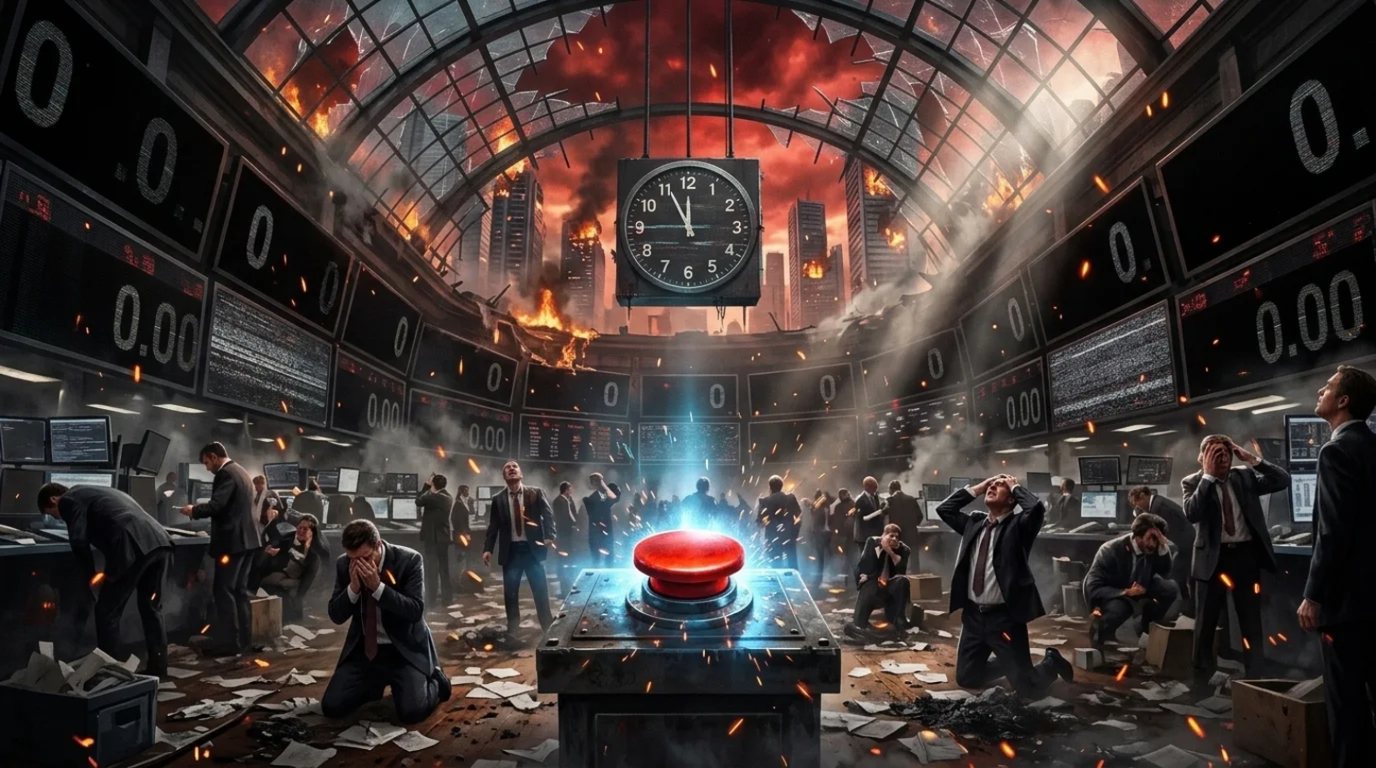
Es beginnt mit einem Flackern. Ein Bildschirm in einem Handelsraum wird schwarz, dann zehn, dann tausend. Die Kurse fallen ins Bodenlose, die Bankautomaten spucken nichts mehr aus, die Ampeln erlöschen, die Uhren an den Bahnhöfen bleiben stehen. Ein Countdown läuft über die letzten funktionierenden Anzeigen: drei, zwei, eins.

Dann ist alles auf null. Jede Schuld ist gelöscht, jedes Konto, jeder Titel, jede Krone. Die Welt drückt auf Neustart.

In den Ruinen der Börsen tanzen die Menschen. Sie umarmen sich, sie verbrennen ihre Mahnbescheide, sie rufen, dass jetzt alles anders wird. Endlich, sagen sie, endlich sind wir frei.

Nur wenige bemerken die Hand, die das Brett abwischt. Sie steckt in einem Handschuh aus Metall, und sie wischt nicht, um aufzuräumen, sondern um Platz zu schaffen. Niemand fragt, wer den Schlüssel zum Neustart in der Tasche hat, wer das neue System schreibt, wer die neuen Regeln bestimmt. Die Menge jubelt. Und irgendwo in einem Raum ohne Fenster beginnt jemand bereits, die nächste Krone zu schmieden.

It begins with a flicker. A screen on a trading floor goes black, then ten, then a thousand. Prices plunge into the abyss, the cash machines spit out nothing more, the traffic lights go dark, the clocks in the railway stations stop. A countdown runs across the last working displays: three, two, one.

Then everything is at zero. Every debt is erased, every account, every title, every crown. The world presses restart.

In the ruins of the stock exchanges people dance. They embrace, they burn their final demands, they shout that now everything will be different. At last, they say, at last we are free.

Only a few notice the hand that wipes the board. It is sheathed in a glove of metal, and it does not wipe in order to clean up, but to make room. No one asks who carries the key to the restart in his pocket, who is writing the new system, who decides the new rules. The crowd cheers. And somewhere in a room without windows, someone has already begun to forge the next crown.

Всё начинается с мерцания. Гаснет один экран в торговом зале, потом десять, потом тысяча. Курсы падают в бездну, банкоматы больше ничего не выдают, гаснут светофоры, останавливаются вокзальные часы. По последним работающим табло бежит обратный отсчёт: три, два, один.

И вот всё обнулено. Стёрт каждый долг, каждый счёт, каждый титул, каждая корона. Мир нажимает на перезагрузку.

В руинах бирж люди танцуют. Они обнимаются, жгут свои долговые извещения, кричат, что теперь всё будет иначе. «Наконец-то, – говорят они, – наконец-то мы свободны».

Лишь немногие замечают руку, которая стирает доску. Она в металлической перчатке, и стирает она не затем, чтобы навести порядок, а затем, чтобы освободить место. Никто не спрашивает, у кого в кармане ключ от перезагрузки, кто пишет новую систему, кто устанавливает новые правила. Толпа ликует. А где-то в комнате без окон кто-то уже начинает ковать следующую корону.

Empieza con un parpadeo. Una pantalla en una sala de operaciones bursátiles se apaga, luego diez, luego mil. Las cotizaciones se desploman sin fondo, los cajeros automáticos ya no escupen nada, los semáforos se extinguen, los relojes de las estaciones se detienen. Una cuenta atrás recorre los últimos paneles que aún funcionan: tres, dos, uno.

Luego todo está en cero. Toda deuda queda borrada, toda cuenta, todo título, toda corona. El mundo pulsa reiniciar.

En las ruinas de las bolsas, la gente baila. Se abrazan, queman sus requerimientos de pago, gritan que ahora todo será distinto. «Por fin», dicen, «por fin somos libres».

Solo unos pocos advierten la mano que limpia el tablero. Está enfundada en un guante de metal, y no limpia para ordenar, sino para hacer sitio. Nadie pregunta quién lleva en el bolsillo la llave del reinicio, quién escribe el nuevo sistema, quién dicta las nuevas reglas. La multitud vitorea. Y en algún lugar, en una habitación sin ventanas, alguien empieza ya a forjar la próxima corona.

Song anhörenListen to the songСлушать песнюEscuchar la canción →
II.05 · heutetodayсегодняhoy

The Dead Ones Waking

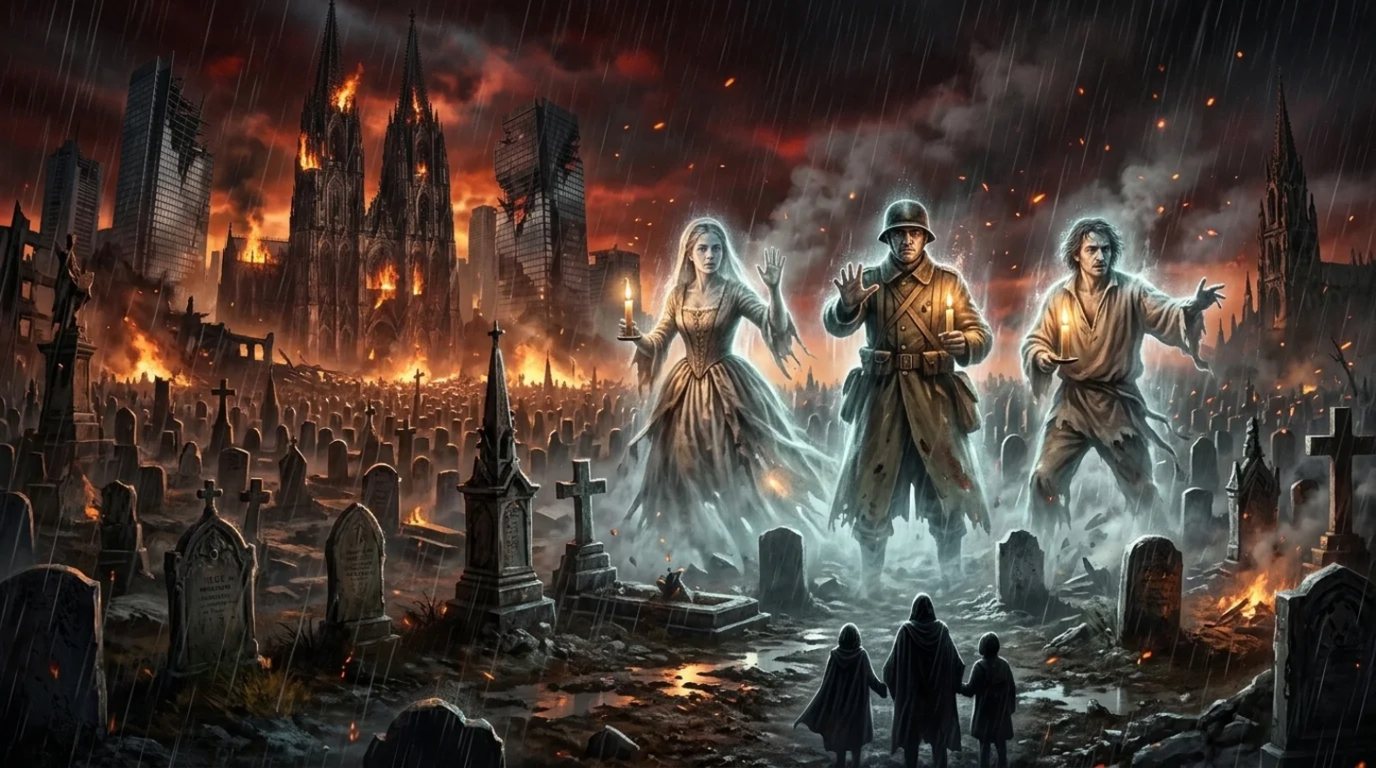
In der Nacht nach dem Neustart wird es still in der Stadt, so still, dass man die Toten hören kann. Auf den Friedhöfen, auf den vergessenen Schlachtfeldern, in den Massengräbern, über die man Straßen gebaut hat, werden die Gefallenen wach. Sie erheben sich als Chor.

Da ist eine Mutter ohne Kinder, die in einem Krieg starb, an den sich niemand mehr erinnert. Ein Soldat ohne Krieg, der für eine Fahne fiel, die heute in einem Museum hängt. Ein Dichter ohne Stimme, dessen Bücher verbrannt wurden. Ein Arbeiter, den man im Fundament einer Kathedrale vergessen hat. Hunderte, Tausende, Millionen.

Sie gehen zwischen den Lebenden umher, unsichtbar, und flüstern ihnen ins Ohr. Sie erzählen, wie es bei ihnen war: wie man ihnen eine glänzende Krone versprochen hat, Sicherheit, Größe, Ordnung. Wie sie gejubelt haben. Wie sie genau dem zugejubelt haben, wovor sie sich am meisten fürchteten. Glaubt nicht an die glänzende Krone, flüstern sie. Wir haben es auch getan. Einige der Lebenden bleiben stehen und hören zu. Die meisten gehen weiter.

On the night after the restart the city falls silent, so silent that you can hear the dead. In the cemeteries, on the forgotten battlefields, in the mass graves over which roads were laid, the fallen awaken. They rise as a choir.

There is a mother without children who died in a war no one remembers anymore. A soldier without a war who fell for a flag that now hangs in a museum. A poet without a voice whose books were burned. A labourer who was forgotten in the foundations of a cathedral. Hundreds, thousands, millions.

They move among the living, unseen, and whisper in their ears. They tell how it was for them: how they were promised a shining crown – security, greatness, order. How they cheered. How they cheered for the very thing they feared most. Do not believe in the shining crown, they whisper. We did too. Some of the living stop and listen. Most walk on.

В ночь после перезагрузки в городе становится тихо, так тихо, что слышно мёртвых. На кладбищах, на забытых полях сражений, в братских могилах, поверх которых проложили улицы, пробуждаются павшие. Они встают хором.

Вот мать без детей, умершая на войне, о которой никто уже не помнит. Солдат без войны, павший за знамя, что висит теперь в музее. Поэт без голоса, чьи книги сожгли. Рабочий, которого забыли в фундаменте собора. Сотни, тысячи, миллионы.

Они ходят среди живых, невидимые, и шепчут им на ухо. Они рассказывают, как было у них: как им обещали сверкающую корону – безопасность, величие, порядок. Как они ликовали. Как рукоплескали именно тому, чего боялись больше всего. «Не верьте сверкающей короне, – шепчут они. – Мы тоже верили». Некоторые из живых останавливаются и слушают. Большинство идёт дальше.

En la noche que sigue al reinicio, la ciudad queda en silencio, tan en silencio que se puede oír a los muertos. En los cementerios, en los campos de batalla olvidados, en las fosas comunes sobre las que se han construido calles, los caídos despiertan. Se alzan como un coro.

Ahí está una madre sin hijos, muerta en una guerra que ya nadie recuerda. Un soldado sin guerra, caído por una bandera que hoy cuelga en un museo. Un poeta sin voz, cuyos libros fueron quemados. Un obrero olvidado en los cimientos de una catedral. Cientos, miles, millones.

Caminan entre los vivos, invisibles, y les susurran al oído. Les cuentan cómo fue en su tiempo: cómo les prometieron una corona reluciente, seguridad, grandeza, orden. Cómo vitorearon. Cómo vitorearon precisamente aquello que más temían. «No crean en la corona reluciente», susurran. «Nosotros también creímos». Algunos de los vivos se detienen y escuchan. La mayoría sigue su camino.

Song anhörenListen to the songСлушать песнюEscuchar la canción →
II.06 · heutetodayсегодняhoy

Overtaking the World

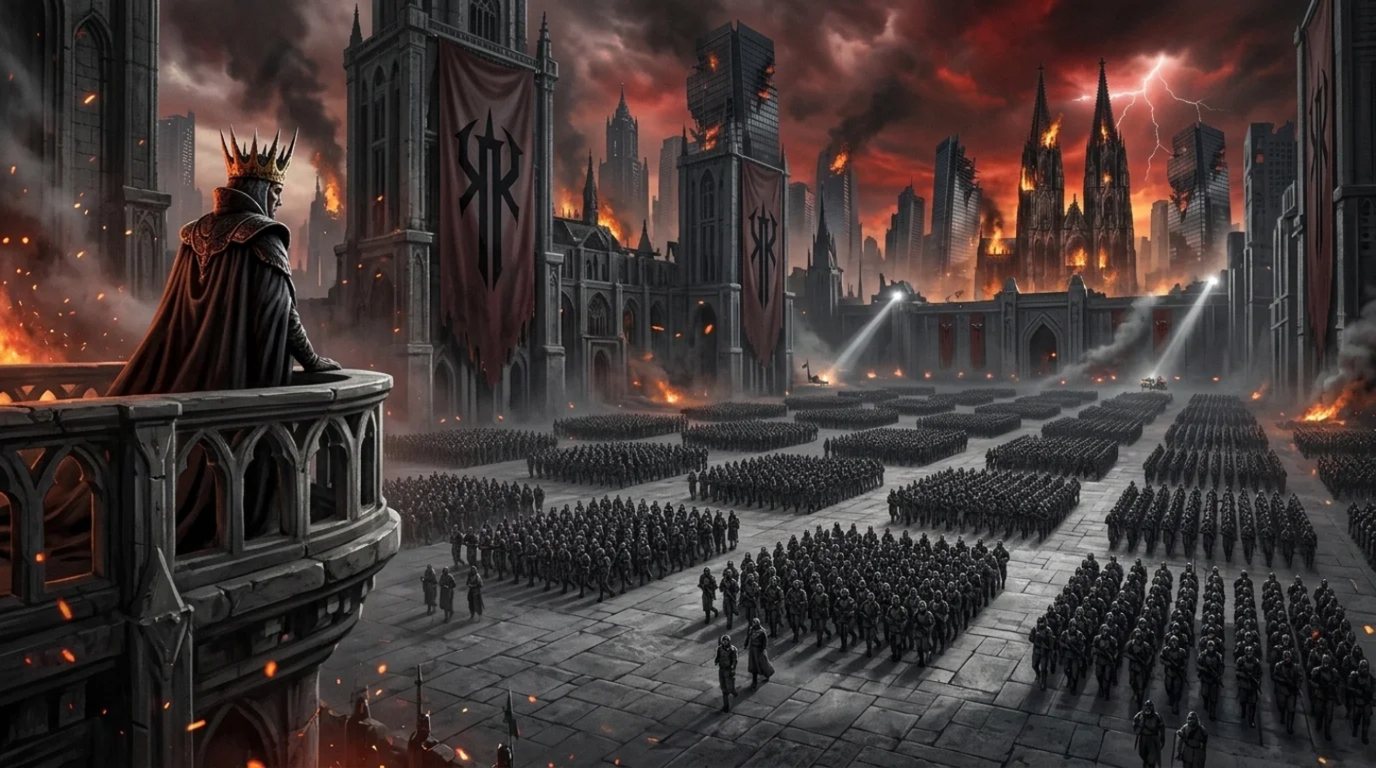
Gestern war er niemand. Ein unauffälliger Mann mit einem freundlichen Gesicht, der in den Tagen des Chaos Suppe an die Hungrigen verteilt und Decken an die Frierenden. Die Menschen mögen ihn. Er hört zu. Er verspricht nichts Großes, nur ein bisschen Ordnung.

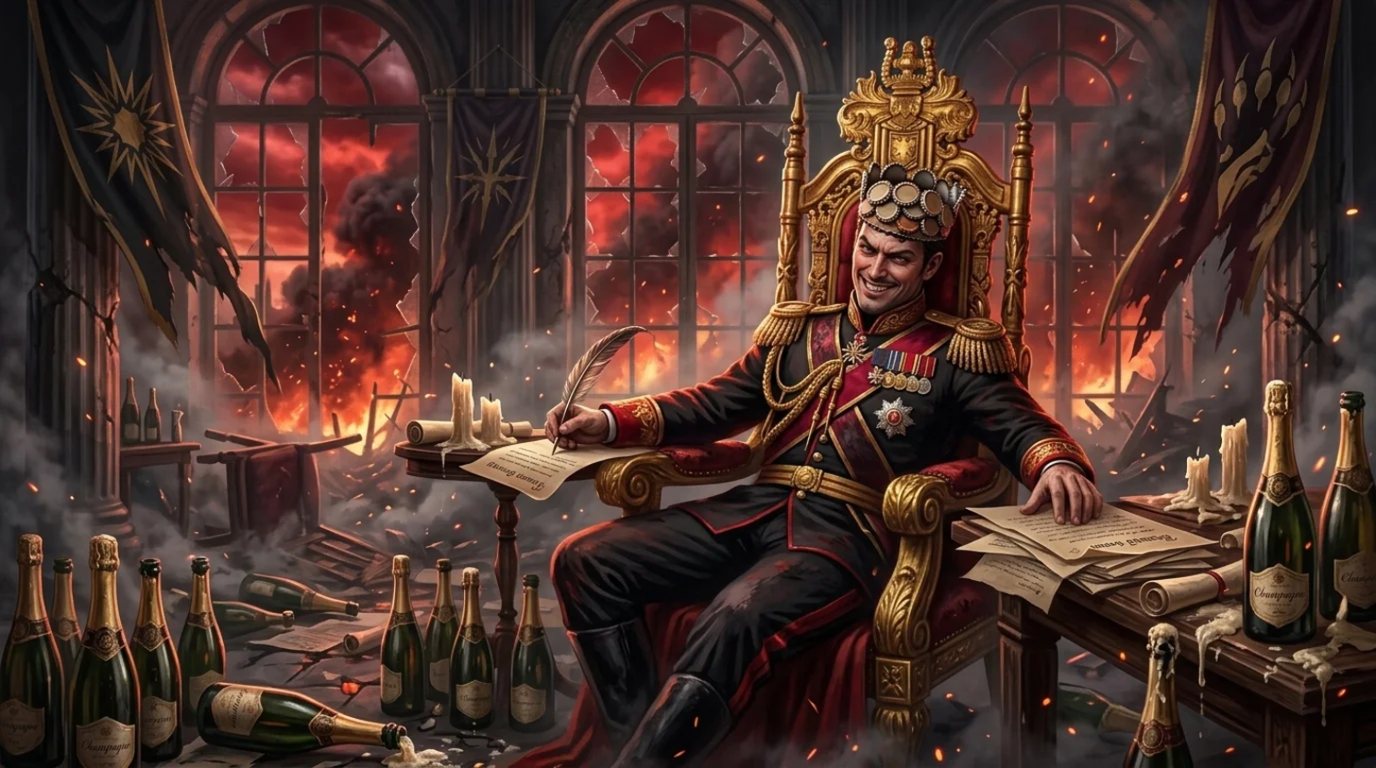
Heute trägt er eine Krone. Sie ist aus einem Kronkorken gebogen, aus Spaß, sagt er, ein Scherz unter Freunden. Aber er unterschreibt bereits Dekrete. Nur eine Ausgangssperre, für die Sicherheit. Nur ein Register, für die Gerechtigkeit. Nur ein bisschen Macht, für den Frieden des Volkes. Jeder Schritt ist klein. Jeder Schritt ist vernünftig. Jeder Schritt wird bejubelt.

In einer Woche hat er ein Büro, in einem Monat eine Garde, in einem Jahr einen Palast. Der Kronkorken ist längst durch Gold ersetzt, und niemand kann genau sagen, wann das passiert ist. Wer ihn an seine Suppenküche erinnert, wird nicht mehr eingeladen. Wer fragt, warum, wird nicht mehr gesehen. Er übernimmt die Welt nicht mit einem Putsch. Er übernimmt sie mit einem Lächeln, Unterschrift für Unterschrift, und die Menschen halten ihm dabei den Stift.

Yesterday he was nobody. An unremarkable man with a friendly face who, in the days of chaos, handed out soup to the hungry and blankets to the cold. People like him. He listens. He promises nothing grand, only a little order.

Today he wears a crown. It is bent from a bottle cap – for fun, he says, a joke among friends. But he is already signing decrees. Only a curfew, for safety. Only a register, for fairness. Only a little power, for the peace of the people. Every step is small. Every step is reasonable. Every step is cheered.

Within a week he has an office, within a month a guard, within a year a palace. The bottle cap has long since been replaced by gold, and no one can say exactly when that happened. Whoever reminds him of his soup kitchen is no longer invited. Whoever asks why is no longer seen. He does not take over the world with a coup. He takes it over with a smile, signature by signature, and the people hold the pen for him.

Вчера он был никем. Неприметный человек с приветливым лицом, который в дни хаоса раздаёт суп голодным и одеяла замёрзшим. Люди любят его. Он умеет слушать. Он не обещает ничего великого, только немного порядка.

Сегодня на нём корона. Она согнута из бутылочной крышки – в шутку, говорит он, шутка между друзьями. Но он уже подписывает указы. Всего лишь комендантский час – ради безопасности. Всего лишь реестр – ради справедливости. Всего лишь немного власти – ради мира в народе. Каждый шаг мал. Каждый шаг разумен. Каждому шагу рукоплещут.

Через неделю у него кабинет, через месяц – гвардия, через год – дворец. Крышку давно сменило золото, и никто толком не скажет, когда это случилось. Кто напоминает ему о его бесплатной кухне, того больше не приглашают. Кто спрашивает почему, того больше не видят. Он захватывает мир не переворотом. Он захватывает его улыбкой, подпись за подписью, и люди сами держат ему перо.

Ayer no era nadie. Un hombre discreto de rostro amable que, en los días del caos, repartía sopa a los hambrientos y mantas a los que tenían frío. La gente lo aprecia. Sabe escuchar. No promete nada grande, solo un poco de orden.

Hoy lleva una corona. La ha doblado de una chapa de botella, en broma, dice, un chiste entre amigos. Pero ya firma decretos. Solo un toque de queda, por la seguridad. Solo un registro, por la justicia. Solo un poco de poder, por la paz del pueblo. Cada paso es pequeño. Cada paso es razonable. Cada paso es aclamado.

En una semana tiene un despacho; en un mes, una guardia; en un año, un palacio. La chapa hace mucho que fue sustituida por oro, y nadie sabría decir exactamente cuándo ocurrió. A quien le recuerda su comedor de beneficencia ya no se le invita. A quien pregunta por qué, ya no se le vuelve a ver. No se adueña del mundo con un golpe de Estado. Se adueña de él con una sonrisa, firma tras firma, y la gente le sostiene la pluma.

Song anhörenListen to the songСлушать песнюEscuchar la canción →
II.07 · heutetodayсегодняhoy

One New World

Eine Stimme, ein Gesetz, eine Richtung. So steht es über den Toren der neuen Welt, in Buchstaben aus Licht, und für eine Weile klingt es wie das Versprechen, auf das alle gewartet haben. Keine Kriege mehr zwischen den Völkern, weil es nur noch ein Volk gibt. Kein Streit mehr über die Wahrheit, weil es nur noch eine Wahrheit gibt.

Die Bildschirme sagen den Menschen, was sie denken sollen, und sie denken es gern, weil es so bequem ist. Die Kameras sehen alles, und wer nichts zu verbergen hat, hat nichts zu befürchten. Wer zweifelt, wird nicht bestraft – er wird korrigiert. Freundlich, geduldig, so lange, bis er nicht mehr zweifelt.

Aber in den Hinterhöfen singen noch immer ein paar Kinder ein altes, einfaches Lied, das niemand mehr kennt. Sie wissen nicht, woher sie es haben. Und an einem Abend, als ein Wärter es zum ersten Mal hört, versteht er etwas, das er nicht verstehen soll: Die Krone der neuen Welt glänzt nicht wie Gold. Sie war von Anfang an aus Eisen.

One voice, one law, one direction. So it stands above the gates of the new world, in letters of light, and for a while it sounds like the promise everyone has been waiting for. No more wars between the nations, because there is only one nation left. No more quarrels over the truth, because there is only one truth left.

The screens tell people what to think, and they are glad to think it, because it is so comfortable. The cameras see everything, and whoever has nothing to hide has nothing to fear. Whoever doubts is not punished – he is corrected. Kindly, patiently, for as long as it takes, until he doubts no more.

But in the back courtyards a few children are still singing an old, simple song that no one knows anymore. They do not know where they learned it. And one evening, when a guard hears it for the first time, he understands something he is not supposed to understand: the crown of the new world does not shine like gold. It was iron from the very beginning.

Один голос, один закон, одно направление. Так написано над воротами нового мира буквами из света, и какое-то время это звучит как обещание, которого ждали все. Больше никаких войн между народами, потому что народ остался один. Больше никаких споров о правде, потому что правда осталась одна.

Экраны говорят людям, что думать, и люди думают это охотно, потому что так удобно. Камеры видят всё, а кому нечего скрывать, тому нечего бояться. Кто сомневается, того не наказывают – его исправляют. Дружелюбно, терпеливо, до тех пор, пока он не перестанет сомневаться.

Но на задних дворах несколько детей всё ещё поют старую простую песню, которой больше никто не знает. Они не знают, откуда она у них. И однажды вечером надзиратель, впервые услышав её, понимает то, чего понимать ему не положено: корона нового мира не блестит, как золото. Она с самого начала была железной.

Una voz, una ley, una dirección. Así está escrito sobre las puertas del nuevo mundo, con letras de luz, y durante un tiempo suena como la promesa que todos esperaban. No más guerras entre los pueblos, porque ya solo hay un pueblo. No más disputas sobre la verdad, porque ya solo hay una verdad.

Las pantallas dicen a la gente lo que debe pensar, y la gente lo piensa con gusto, porque es tan cómodo. Las cámaras lo ven todo, y quien nada tiene que ocultar, nada tiene que temer. Quien duda no es castigado: es corregido. Con amabilidad, con paciencia, hasta que deja de dudar.

Pero en los patios traseros, unos cuantos niños siguen cantando una canción antigua y sencilla que ya nadie conoce. No saben de dónde la han sacado. Y una tarde, cuando un guardián la oye por primera vez, comprende algo que no debería comprender: la corona del nuevo mundo no brilla como el oro. Fue de hierro desde el principio.

Song anhörenListen to the songСлушать песнюEscuchar la canción →
II.08 · heutetodayсегодняhoy

Third World War

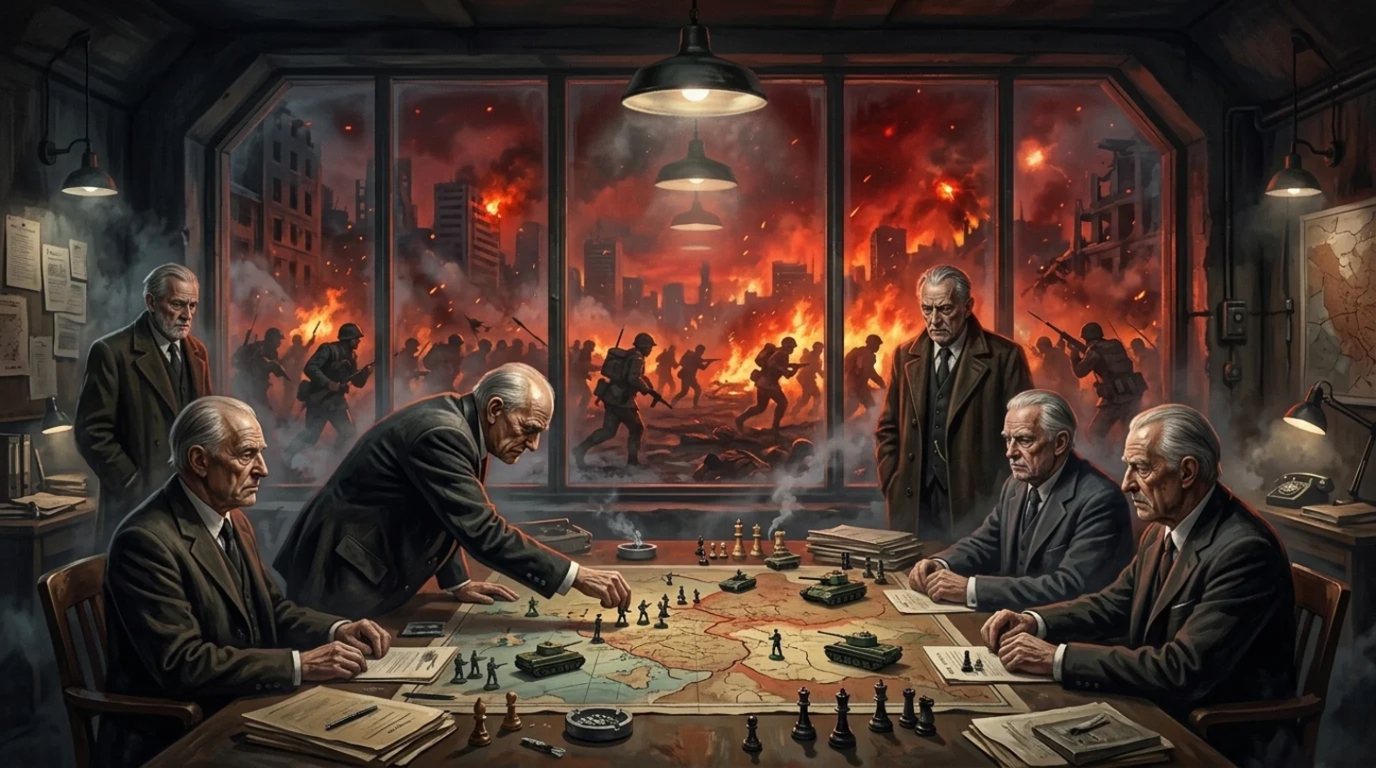
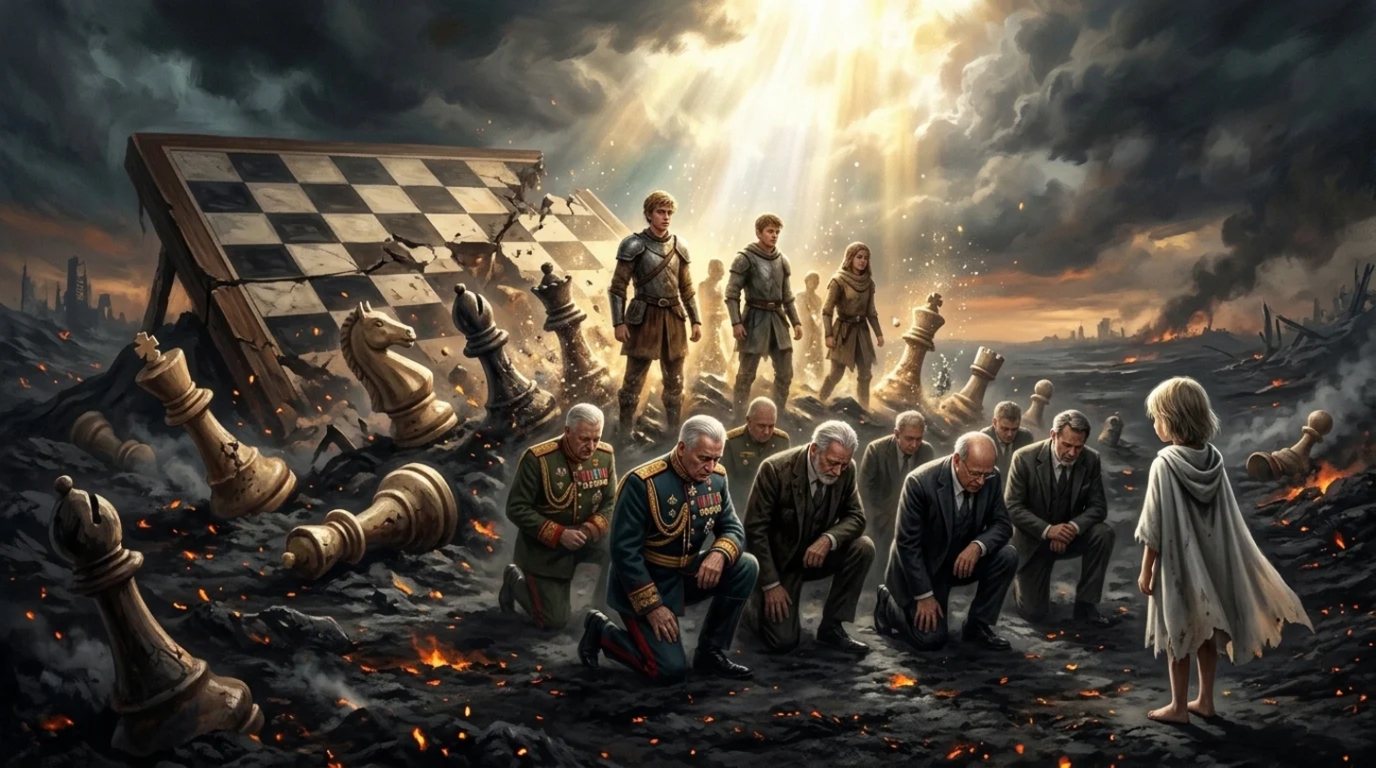
In einem Saal hoch über der Stadt sitzen zwei alte Männer an einem Schachbrett. Sie sind höflich zueinander, sie trinken guten Wein, sie kennen sich seit Jahrzehnten. Ihre Figuren sind keine Figuren. Es sind Divisionen, Flotten, Städte, Länder – und darin junge Menschen, die nie gefragt wurden.

Draußen nähren die Jungen das Feuer. Sie glauben, sie kämpfen für ihre Heimat, für ihre Familien, für die Freiheit. Auf beiden Seiten glauben sie das. Auf beiden Seiten singen sie dieselben Lieder mit anderen Worten. Die Fronten wandern über die Karten, die Sirenen heulen in den Nächten, und die alten Männer schieben eine Figur ein Feld weiter.

Irgendwann steht einer der Männer am Fenster und sieht die brennende Stadt. Er sagt nichts. Der andere sagt: Der Teufel brauchte keine Tür. Er meint es als Entschuldigung. Aber es ist ein Geständnis. Niemand hat das Böse hereingebrochen. Man hat ihm geöffnet, Zug um Zug, aus Angst, aus Ehrgeiz, aus Gewohnheit. Wir haben ihn hereingelassen. Und jetzt sitzt er mit am Tisch und schenkt den Wein nach.

In a hall high above the city, two old men sit at a chessboard. They are courteous to each other, they drink good wine, they have known each other for decades. Their pieces are not pieces. They are divisions, fleets, cities, countries – and within them young people who were never asked.

Outside, the young feed the fire. They believe they are fighting for their homeland, for their families, for freedom. On both sides they believe it. On both sides they sing the same songs with different words. The front lines wander across the maps, the sirens wail through the nights, and the old men move a piece one square further.

At some point one of the men stands at the window and looks at the burning city. He says nothing. The other says: The devil needed no door. He means it as an excuse. But it is a confession. No one broke evil in. It was let in, move by move, out of fear, out of ambition, out of habit. We let him in. And now he sits with us at the table and fills the glasses again.

В зале высоко над городом за шахматной доской сидят два старика. Они вежливы друг с другом, пьют хорошее вино, знакомы десятки лет. Их фигуры – не фигуры. Это дивизии, флоты, города, страны – и в них молодые люди, которых никто никогда ни о чём не спрашивал.

Снаружи молодые питают собой огонь. Они верят, что сражаются за родину, за свои семьи, за свободу. По обе стороны верят в это. По обе стороны поют одни и те же песни другими словами. Линии фронта ползут по картам, по ночам воют сирены, а старики передвигают фигуру на одну клетку.

Однажды один из них стоит у окна и смотрит на горящий город. Он молчит. Другой говорит: «Дьяволу не понадобилась дверь». Он говорит это в оправдание. Но это признание. Зло не врывалось силой. Ему открывали, ход за ходом, из страха, из честолюбия, по привычке. Мы сами его впустили. И теперь он сидит с нами за столом и подливает вино.

En una sala muy por encima de la ciudad, dos ancianos están sentados ante un tablero de ajedrez. Son corteses el uno con el otro, beben buen vino, se conocen desde hace décadas. Sus piezas no son piezas. Son divisiones, flotas, ciudades, países, y dentro de ellos, gente joven a la que nunca se le preguntó nada.

Afuera, los jóvenes alimentan el fuego. Creen que luchan por su patria, por sus familias, por la libertad. En ambos bandos lo creen. En ambos bandos cantan las mismas canciones con otras palabras. Los frentes se desplazan sobre los mapas, las sirenas aúllan en las noches, y los ancianos mueven una pieza una casilla más.

En algún momento, uno de ellos se asoma a la ventana y contempla la ciudad en llamas. No dice nada. El otro dice: «El diablo no necesitó ninguna puerta». Lo dice como excusa. Pero es una confesión. Nadie forzó la entrada del mal. Se le abrió, jugada tras jugada, por miedo, por ambición, por costumbre. Nosotros lo dejamos entrar. Y ahora se sienta a la mesa con ellos y les vuelve a llenar las copas.

Song anhörenListen to the songСлушать песнюEscuchar la canción →
II.09 · heutetodayсегодняhoy

Gog versus Magog

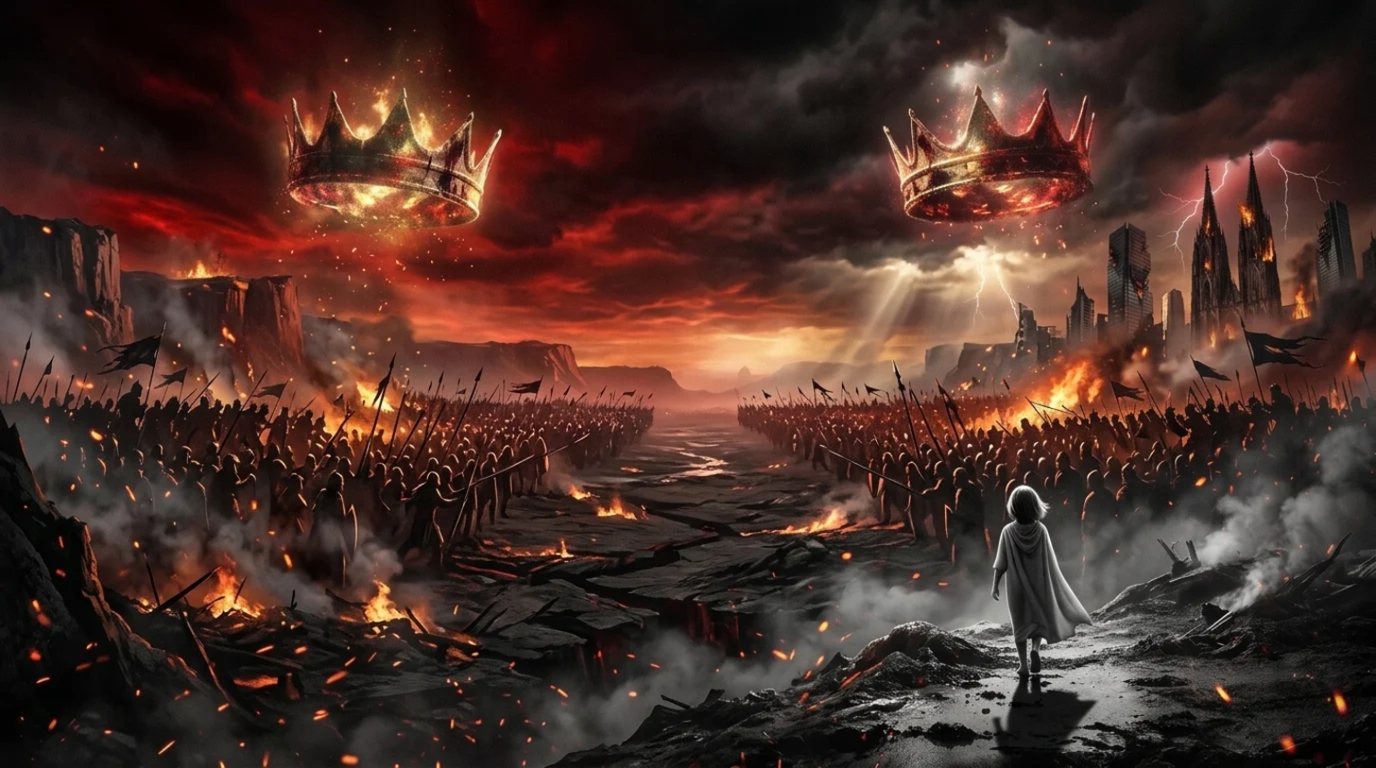
Am Rand aller Zeitalter liegt eine Ebene, auf der nichts mehr wächst. Dort stehen sich zwei Heere gegenüber, so groß, dass ihre Feuer den Horizont von beiden Seiten erleuchten. Auf der einen Seite die Banner von Gog, auf der anderen die von Magog. Ihre Kronen sind verschieden geschmiedet, ihre Hymnen verschieden komponiert, ihre Feinde verschieden benannt. Wenn man genau hinsieht, sind sie dieselben.

Eine lange Nacht lang ist es still. Keiner wagt den ersten Schritt. Dann, im Morgengrauen, beginnt die letzte Schlacht, und sie ist so groß, dass die Erde bebt und der Himmel sich verdunkelt. Es gibt keinen Plan mehr, keinen Sieg, den man feiern könnte, nur noch Feuer.

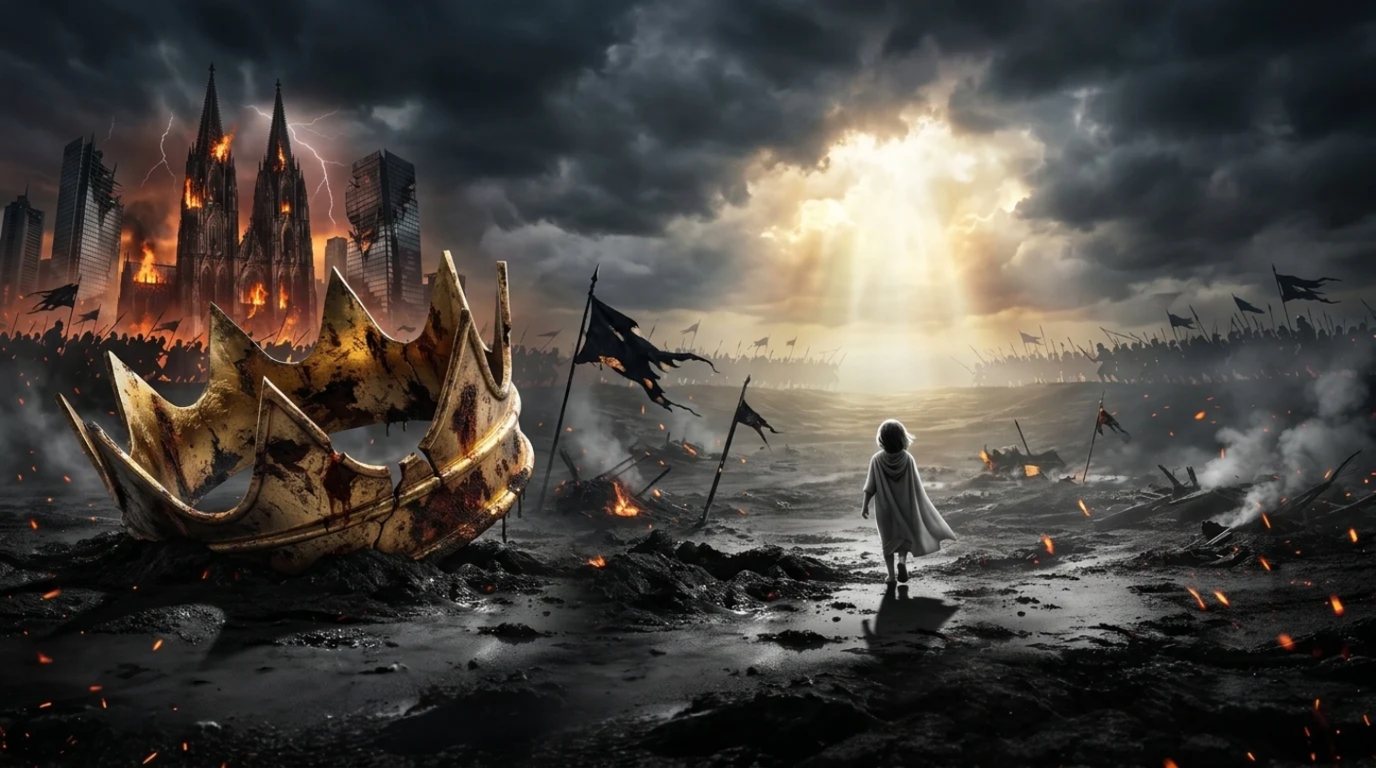
Als sich der Rauch endlich lichtet, liegen beide Kronen im Schlamm. Kein Heer steht mehr, kein Feldherr, kein Banner. Gog gegen Magog – und niemand hat gewonnen.

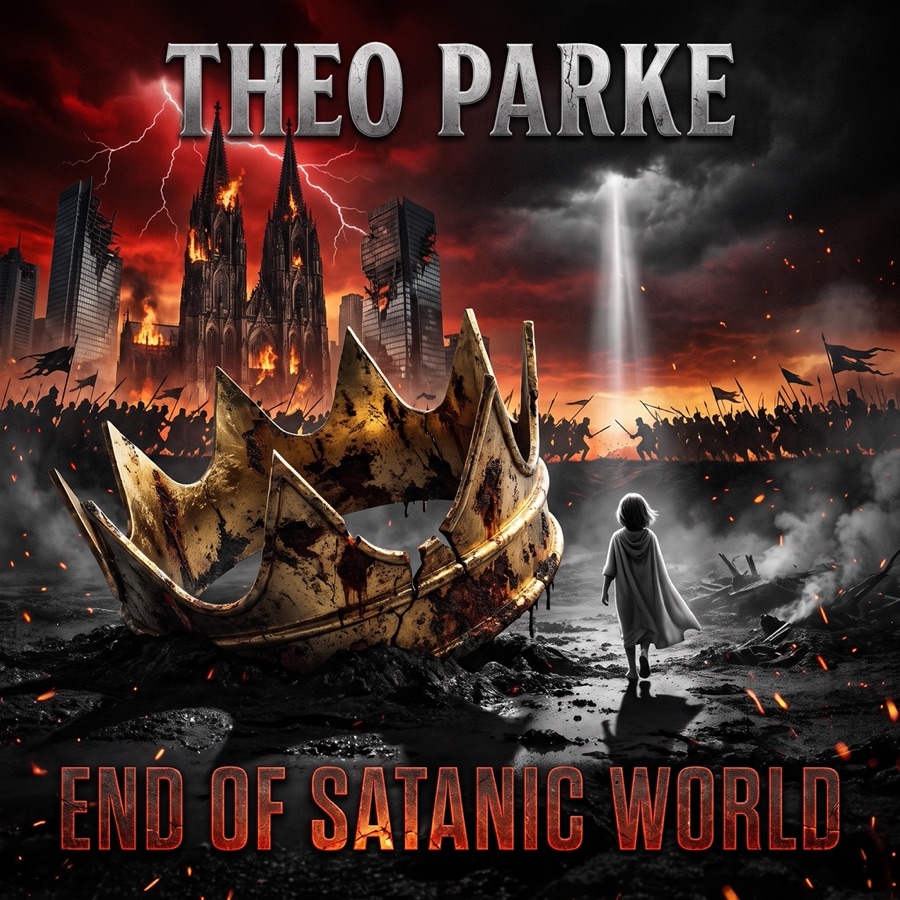
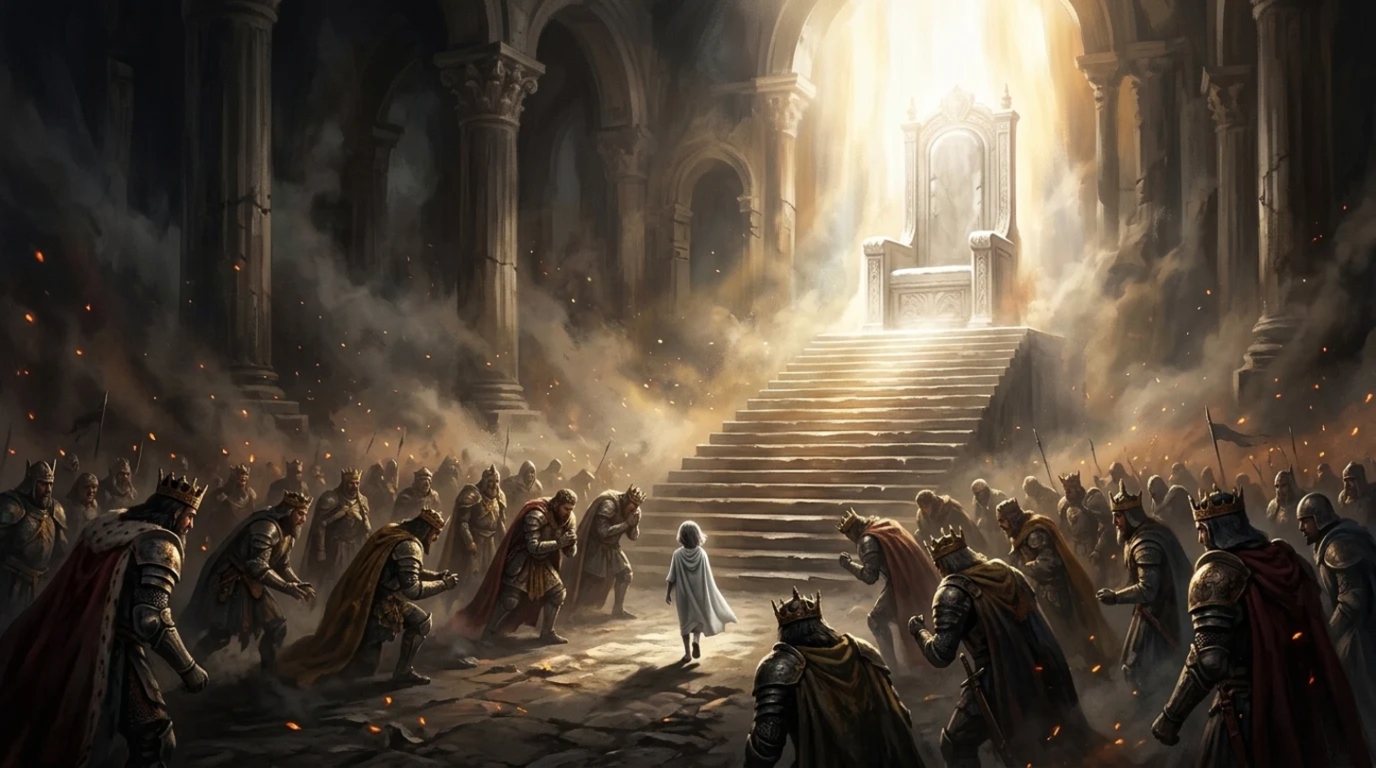
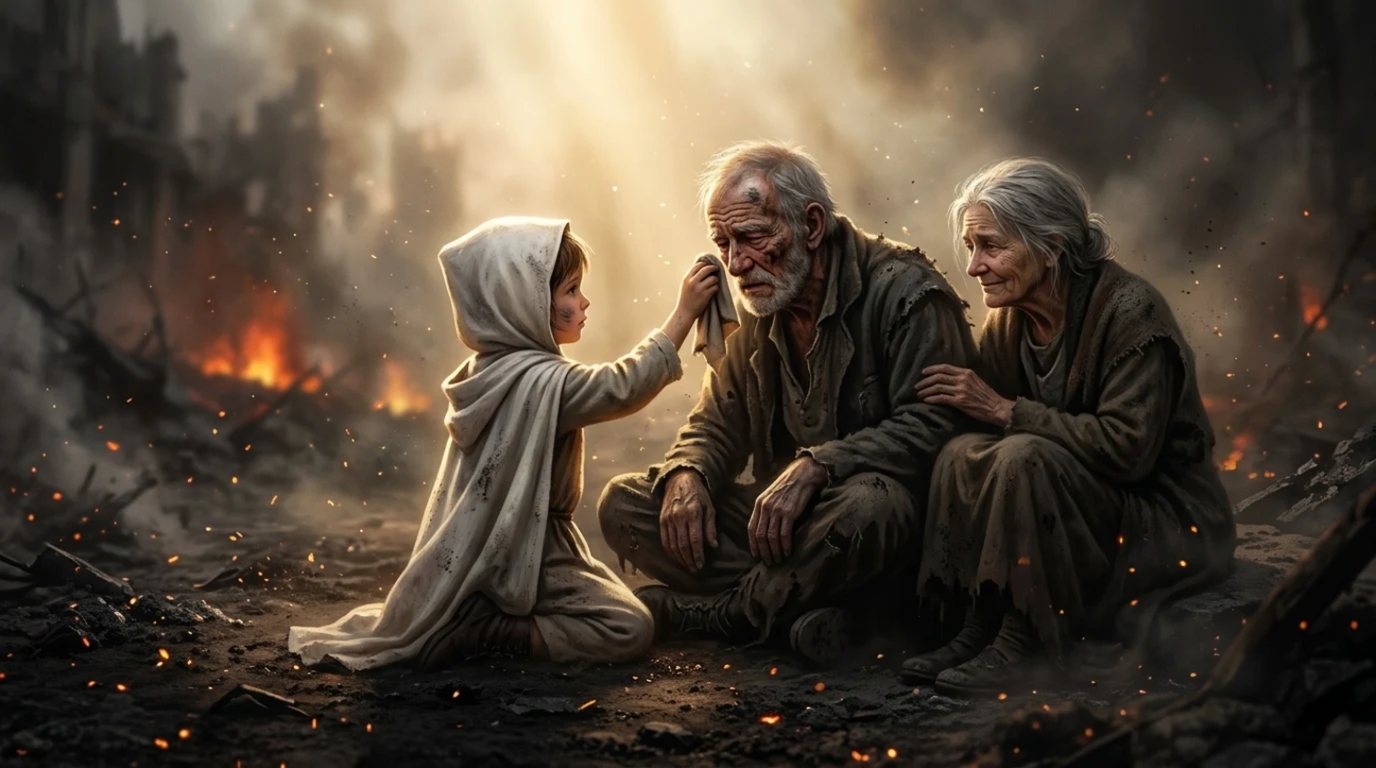
In der Stille danach geht eine kleine Gestalt im weißen Mantel über das Feld. Sie singt leise ein Lied, das die Welt vor tausend Jahren gekannt und wieder vergessen hat. Die satanische Welt endet nicht mit einem Sieger. Sie endet mit einem Kind, das singt.

At the edge of all the ages lies a plain where nothing grows anymore. There two armies face each other, so vast that their fires light the horizon from both sides. On one side the banners of Gog, on the other those of Magog. Their crowns are forged differently, their anthems composed differently, their enemies named differently. Look closely, and they are the same.

For one long night all is still. No one dares the first step. Then, at dawn, the last battle begins, and it is so great that the earth trembles and the sky grows dark. There is no plan anymore, no victory anyone could celebrate, only fire.

When the smoke at last clears, both crowns lie in the mud. No army stands, no commander, no banner. Gog against Magog – and no one has won.

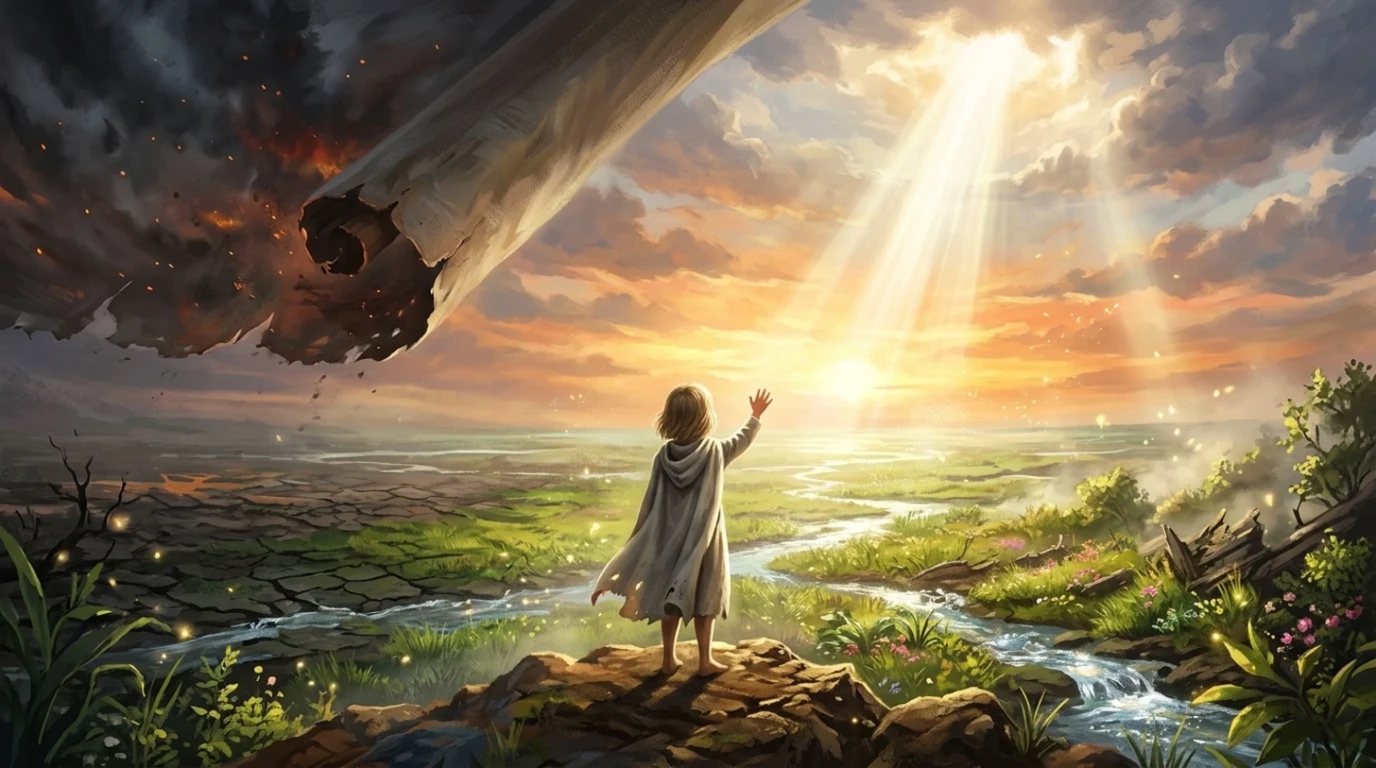
In the silence afterwards a small figure in a white cloak walks across the field. Softly it sings a song the world knew a thousand years ago and then forgot. The satanic world does not end with a victor. It ends with a child, singing.

На краю всех эпох лежит равнина, где больше ничего не растёт. Там стоят друг против друга два войска, столь огромные, что их костры освещают горизонт с обеих сторон. С одной стороны – знамёна Гога, с другой – знамёна Магога. Их короны выкованы по-разному, их гимны сложены по-разному, их враги названы по-разному. Если всмотреться, они одинаковы.

Долгую ночь стоит тишина. Никто не решается сделать первый шаг. Потом, на рассвете, начинается последняя битва, и она так велика, что дрожит земля и меркнет небо. Нет больше ни плана, ни победы, которую можно было бы праздновать, – только огонь.

Когда дым наконец рассеивается, обе короны лежат в грязи. Не устояло ни войско, ни полководец, ни знамя. Гог против Магога – и никто не победил.

В наступившей тишине по полю идёт маленькая фигура в белом плаще. Она тихо поёт песню, которую мир знал тысячу лет назад и снова забыл. Сатанинский мир кончается не победителем. Он кончается ребёнком, который поёт.

En el confín de todas las edades se extiende una llanura donde ya nada crece. Allí se enfrentan dos ejércitos, tan inmensos que sus hogueras iluminan el horizonte por ambos lados. De un lado, los estandartes de Gog; del otro, los de Magog. Sus coronas están forjadas de distinto modo, sus himnos compuestos de distinto modo, sus enemigos nombrados de distinto modo. Si se mira con atención, son los mismos.

Durante una larga noche reina el silencio. Nadie se atreve a dar el primer paso. Luego, al despuntar el alba, comienza la última batalla, y es tan grande que la tierra tiembla y el cielo se oscurece. Ya no hay plan, ni victoria que celebrar; solo fuego.

Cuando por fin se disipa el humo, ambas coronas yacen en el fango. No queda en pie ningún ejército, ningún caudillo, ningún estandarte. Gog contra Magog, y nadie ha ganado.

En el silencio que sigue, una pequeña figura de manto blanco atraviesa el campo. Canta en voz baja una canción que el mundo conoció hace mil años y volvió a olvidar. El mundo satánico no termina con un vencedor. Termina con un niño que canta.

Song anhörenListen to the songСлушать песнюEscuchar la canción →
TeilPartЧастьParte III · Das Gericht und die neue WeltThe judgement and the new worldСуд и новый мирEl juicio y el mundo nuevo

All Things New

Teil III der Geschichte · Das Gericht und die neue WeltPart III of the story · The judgement and the new worldЧасть III истории · Суд и новый мирParte III de la historia · El juicio y el mundo nuevo

Der dritte Teil beginnt in der Stille nach dem Feuer. Keine Fahne steht mehr, keine Sirene heult, der Himmel scheint die Menschen vergessen zu haben. Da erscheint ein großer weißer Thron – und er bleibt leer. Kein Sieger, kein Feldherr, kein Bankier kann ihn besteigen. Erst als sich die Menge teilt, geht das Kind im weißen Mantel die Stufen hinauf. Es öffnet die Bücher, vor ihm knien die alten Männer, das Meer gibt seine Toten heraus, und jeder Mensch muss eine einzige Frage beantworten. Dann versinkt die Schlange im Feuersee, der erste Himmel vergeht, und Gott macht alles neu. Die Geschichte endet nicht mit einem Sieg, sondern mit einem Fluss.

The third part begins in the silence after the fire. No flag still stands, no siren wails, and heaven seems to have forgotten humankind. Then a great white throne appears – and it remains empty. No victor, no commander, no banker can ascend it. Only when the crowd parts does the child in the white cloak climb the steps. It opens the books, the old men kneel before it, the sea gives up the dead which are in it, and every human being must answer a single question. Then the serpent sinks into the lake of fire, the first heaven passes away, and God makes all things new. The story does not end with a victory, but with a river.

Третья часть начинается в тишине после огня. Не стоит больше ни одно знамя, не воет ни одна сирена, и небо, кажется, забыло о людях. И тогда является великий белый престол – и остаётся пустым. Ни победитель, ни полководец, ни банкир не может взойти на него. Лишь когда толпа расступается, по ступеням поднимается дитя в белом плаще. Оно раскрывает книги, перед ним преклоняют колени старики, море отдаёт мёртвых, бывших в нём, и каждый человек должен ответить на один-единственный вопрос. Затем Змей низвергается в озеро огненное, первое небо проходит, и Бог творит всё новое. История заканчивается не победой, а рекой.

La tercera parte comienza en el silencio que sigue al fuego. Ya no queda en pie ninguna bandera, ninguna sirena aúlla, el cielo parece haberse olvidado de los hombres. Entonces aparece un gran trono blanco, y permanece vacío. Ningún vencedor, ningún caudillo, ningún banquero logra ascender a él. Solo cuando la multitud se abre, el niño del manto blanco sube los peldaños. Abre los libros, los ancianos se postran ante él, el mar entrega los muertos que había en él, y cada ser humano ha de responder a una sola pregunta. Luego la serpiente se hunde en el lago de fuego, el primer cielo pasa, y Dios hace nuevas todas las cosas. La historia no termina con una victoria, sino con un río.

III.01 · danachafterпослеdespués

After the Fire

Danach. Keine Sirenen mehr, keine Trommeln. Nur Asche, so weit man sehen kann, und ein Fluss, der grau durch die Ebene fließt. Jedes Banner ist bis auf den Faden verbrannt, jeder König liegt unter den Toten. Die Sterne stehen am Himmel, aber sie scheinen weit weg, als hätte der Himmel vergessen, dass hier unten einmal Menschen gelebt haben.

Die wenigen Überlebenden gehen schweigend umher. Die Stille hat einen Klang, wie ein Herzschlag unter der Erde. Im Lehm liegt eine zerbrochene Krone. Niemand wagt, sie aufzuheben. Man umgeht sie, wie man eine Schlange umgeht.

Auf einem Stein am Weg sitzt eine Frau und zählt die Namen derer, die sie verloren hat. Sie erinnert sich an Geschichten aus alter Zeit – von Türmen, die man gebaut hat, von Regen, den man verkauft hat, von Worten wie Freiheit und Gewinn, die man so lange benutzt hat, bis sie nichts mehr bedeuteten. Jedes dieser Worte, denkt sie, steht irgendwo geschrieben, schwarz und rot.

Durch die Nacht geht ein Kind im weißen Mantel. Es spricht nicht, es weint nicht. Es geht an den Lebenden und den Sterbenden vorbei, und niemand bemerkt es.

Afterwards. No more sirens, no more drums. Only ash, as far as the eye can see, and a river flowing grey across the plain. Every banner has burned down to the last thread, every king lies among the dead. The stars stand in the sky, but they seem far away, as though heaven had forgotten that people once lived down here.

The few survivors wander about in silence. The stillness has a sound, like a heartbeat beneath the earth. A broken crown lies in the clay. No one dares to pick it up. People step around it, the way one steps around a snake.

On a stone by the path sits a woman, counting the names of those she has lost. She remembers stories from long ago – of towers that were built, of rain that was sold, of words like freedom and profit that were used for so long that they no longer meant anything. Each of those words, she thinks, is written down somewhere, in black and in red.

Through the night walks a child in a white cloak. It does not speak, it does not weep. It walks past the living and the dying, and no one notices it.

После. Ни сирен, ни барабанов. Только пепел, насколько хватает глаз, и река, что серой лентой течёт по равнине. Каждое знамя сгорело до последней нити, каждый король лежит среди мёртвых. Звёзды стоят в небе, но кажутся далёкими, будто небо забыло, что здесь, внизу, когда-то жили люди.

Немногие уцелевшие молча бродят вокруг. У тишины есть звук – словно под землёй бьётся сердце. В глине лежит сломанная корона. Никто не решается её поднять. Её обходят, как обходят змею.

На камне у дороги сидит женщина и считает имена тех, кого потеряла. Она вспоминает истории давних времён – о башнях, которые строили, о дожде, который продавали, о словах вроде «свобода» и «прибыль», которыми пользовались так долго, что они перестали что-либо значить. Каждое из этих слов, думает она, где-то записано – чёрным и красным.

Сквозь ночь идёт дитя в белом плаще. Оно не говорит, не плачет. Оно проходит мимо живых и умирающих, и никто его не замечает.

Después. Ya no hay sirenas, ni tambores. Solo ceniza hasta donde alcanza la vista, y un río que corre gris por la llanura. Cada estandarte ha ardido hasta el último hilo, cada rey yace entre los muertos. Las estrellas están en el cielo, pero parecen lejanas, como si el cielo hubiera olvidado que aquí abajo vivieron alguna vez seres humanos.

Los pocos sobrevivientes deambulan en silencio. El silencio tiene un sonido, como un latido bajo la tierra. En el barro yace una corona rota. Nadie se atreve a recogerla. La rodean como se rodea a una serpiente.

Sobre una piedra junto al camino, una mujer cuenta los nombres de los que ha perdido. Recuerda historias de tiempos antiguos: de torres que se construyeron, de lluvia que se vendió, de palabras como libertad y ganancia, usadas tanto tiempo que acabaron por no significar nada. Cada una de esas palabras, piensa, está escrita en alguna parte, en negro y en rojo.

A través de la noche camina un niño de manto blanco. No habla, no llora. Pasa junto a los vivos y a los moribundos, y nadie lo advierte.

Song anhörenListen to the songСлушать песнюEscuchar la canción →
III.02 · danachafterпослеdespués

A Child Upon the Throne

Am Morgen steht ein Thron auf der Ebene. Niemand hat ihn gebaut, niemand hat ihn kommen sehen. Er ist groß und so weiß, dass er die Dunkelheit aus der Nacht brennt, und vor seinem Licht fliehen Erde und Himmel. Die Überlebenden kommen von allen Seiten und bleiben in weitem Abstand stehen.

Der Thron ist leer.

Zuerst treten die Mächtigen vor, die noch übrig sind. Ein General in zerrissener Uniform steigt die erste Stufe hinauf und kommt nicht weiter, als hielte ihn eine unsichtbare Hand. Ein Bankier versucht es, ein Fürst, ein Prophet mit glänzenden Augen. Keiner erreicht den Sitz. Keine Krone und kein Schwert können ihn kaufen.

Wer ist würdig?, flüstert die Menge. Da beginnt sie sich zu teilen, ohne dass jemand es befiehlt. Durch die Gasse kommt das Kind im weißen Mantel, klein und still, ohne Soldaten, ohne Ring, ohne ein Wort. Ihr habt mich in Palästen gesucht, scheint sein Blick zu sagen, ihr habt mich im Krieg gesucht – ich stand bei den Kleinen, auf die ihr nie gewartet habt. Dann steigt es die Stufen hinauf, setzt sich, und der Thron leuchtet.

In the morning a throne stands on the plain. No one built it, no one saw it come. It is great, and so white that it burns the darkness out of the night, and from its light the earth and the heaven flee away. The survivors come from every direction and stop at a wide distance.

The throne is empty.

First the powerful step forward, those who remain. A general in a torn uniform climbs the first step and gets no further, as if held back by an invisible hand. A banker tries, a prince, a prophet with shining eyes. None of them reaches the seat. No crown and no sword can buy it.

Who is worthy?, the crowd whispers. Then it begins to part, though no one commands it. Through the opening comes the child in the white cloak, small and quiet, without soldiers, without a ring, without a word. You looked for me in palaces, its gaze seems to say; you looked for me in war – I stood among the little ones you never waited for. Then it climbs the steps, sits down, and the throne shines.

Утром на равнине стоит престол. Никто его не строил, никто не видел, как он появился. Он велик и так бел, что выжигает тьму из ночи, и от его света бегут земля и небо. Уцелевшие сходятся со всех сторон и останавливаются поодаль.

Престол пуст.

Первыми выступают вперёд те из сильных мира, кто ещё остался. Генерал в изорванном мундире поднимается на первую ступень и не может двинуться дальше, словно его держит невидимая рука. Пробует банкир, пробует князь, пробует пророк с блестящими глазами. Никому не удаётся сесть. Ни корона, ни меч не могут купить это место.

«Кто достоин?» – шепчет толпа. И она начинает расступаться, хотя никто этого не приказывал. По открывшемуся проходу идёт дитя в белом плаще, маленькое и тихое, без солдат, без перстня, без единого слова. «Вы искали меня во дворцах, – словно говорит его взгляд, – вы искали меня на войне, а я – среди малых, которых вы никогда не ждали». Потом оно поднимается по ступеням, садится, и престол сияет.

Por la mañana hay un trono en la llanura. Nadie lo ha construido, nadie lo ha visto llegar. Es un gran trono blanco, tan blanco que quema la oscuridad de la noche, y de delante de su luz huyen la tierra y el cielo. Los sobrevivientes acuden de todas partes y se detienen a gran distancia.

El trono está vacío.

Primero se adelantan los poderosos que aún quedan. Un general de uniforme desgarrado sube el primer peldaño y no logra pasar de ahí, como si lo retuviera una mano invisible. Lo intenta un banquero, un príncipe, un profeta de ojos brillantes. Ninguno alcanza el asiento. Ni corona ni espada pueden comprarlo.

«¿Quién es digno?», susurra la multitud. Entonces empieza a abrirse, sin que nadie lo ordene. Por el pasillo avanza el niño del manto blanco, pequeño y callado, sin soldados, sin anillo, sin una palabra. «Me buscaron en palacios», parece decir su mirada, «me buscaron en la guerra; yo estaba con los pequeños, a quienes ustedes nunca esperaron». Luego sube los peldaños, se sienta, y el trono resplandece.

Song anhörenListen to the songСлушать песнюEscuchar la canción →
III.03 · danachafterпослеdespués

The Books Were Opened

Das Kind auf dem Thron hebt die Hand, und Bücher werden gebracht. Unzählige Bücher, in Leder gebunden, so alt, dass ihre Seiten nach Staub und Weihrauch riechen. Niemand weiß, wer sie geschrieben hat. Die Schrift darin ist gleichmäßig und ruhig, geschrieben von einer Hand, die nicht altert.

Das Kind schlägt das erste Buch auf. Darin steht jedes Versprechen, das je gegeben wurde – das gehaltene und das gebrochene. Jede Münze, die je den Besitzer gewechselt hat, und wofür. Jede Wahrheit, die verschwiegen wurde, weil sie unbequem war. Jedes Lied, das ein Kind gesungen hat, als niemand zuhörte.

Die Menschen auf der Ebene erstarren. Sie sehen ihre eigenen Namen auf den Seiten, und neben jedem Namen eine Geschichte, die sie längst vergessen hatten oder vergessen wollten. Ein Mann, der sich für gerecht hielt, findet eine Lüge, die er vor vierzig Jahren erzählt hat. Eine Frau, die sich für unbedeutend hielt, findet eine Seite voller kleiner, guter Taten, an die sie sich selbst nicht mehr erinnert.

Nichts ist verloren gegangen. Nichts ist vergessen. Die Bücher sind geöffnet, und niemand kann sie mehr schließen.

The child on the throne raises its hand, and books are brought. Countless books, bound in leather, so old that their pages smell of dust and incense. No one knows who wrote them. The script within is even and calm, written by a hand that does not age.

The child opens the first book. In it stands every promise ever made – the kept and the broken. Every coin that ever changed hands, and what it was spent on. Every truth that was kept silent because it was inconvenient. Every song a child sang when no one was listening.

The people on the plain freeze. They see their own names on the pages, and beside each name a story they had long forgotten or wished to forget. A man who thought himself righteous finds a lie he told forty years ago. A woman who thought herself insignificant finds a page full of small, good deeds that she herself no longer remembers.

Nothing has been lost. Nothing is forgotten. The books are opened, and no one can close them again.

Дитя на престоле поднимает руку, и приносят книги. Бесчисленные книги в кожаных переплётах, такие древние, что страницы их пахнут пылью и ладаном. Никто не знает, кто их написал. Письмо в них ровное и спокойное, выведенное рукой, которая не стареет.

Дитя раскрывает первую книгу. В ней записано каждое обещание, когда-либо данное, – сдержанное и нарушенное. Каждая монета, когда-либо переходившая из рук в руки, и за что. Каждая правда, которую замалчивали, потому что она была неудобна. Каждая песня, которую ребёнок пел, когда никто не слушал.

Люди на равнине застывают. Они видят на страницах свои имена, и рядом с каждым именем – историю, которую давно забыли или хотели забыть. Человек, считавший себя праведным, находит ложь, сказанную сорок лет назад. Женщина, считавшая себя незначительной, находит страницу, полную маленьких добрых дел, которых сама уже не помнит.

Ничто не пропало. Ничто не забыто. Книги раскрыты, и никто больше не может их закрыть.

El niño en el trono alza la mano, y traen libros. Libros innumerables, encuadernados en cuero, tan antiguos que sus páginas huelen a polvo y a incienso. Nadie sabe quién los escribió. La letra que contienen es pareja y serena, trazada por una mano que no envejece.

El niño abre el primer libro. En él consta cada promesa que se hizo jamás, la cumplida y la quebrantada. Cada moneda que cambió alguna vez de dueño, y a cambio de qué. Cada verdad que se calló por incómoda. Cada canción que un niño cantó cuando nadie escuchaba.

La gente en la llanura se queda inmóvil. Ven sus propios nombres en las páginas, y junto a cada nombre una historia que habían olvidado hace mucho o que querían olvidar. Un hombre que se tenía por justo encuentra una mentira que contó hace cuarenta años. Una mujer que se tenía por insignificante encuentra una página llena de pequeñas buenas obras que ella misma ya no recuerda.

Nada se ha perdido. Nada está olvidado. Los libros fueron abiertos, y ya nadie puede cerrarlos.

Song anhörenListen to the songСлушать песнюEscuchar la canción →
III.04 · danachafterпослеdespués

The Old Men Kneel

Vor dem Thron versammeln sich die alten Männer. Die Generäle, die Bankiers, die Präsidenten, die Strategen – alle, die einmal die Figuren auf dem großen Brett gezogen haben. Sie tragen noch ihre Abzeichen und Orden, aber das Metall ist matt geworden, und ihre Hände zittern.

Sie haben ein Leben lang Entscheidungen getroffen, deren Folgen andere tragen mussten. Sie haben in Sälen mit gutem Wein über Divisionen gesprochen wie über Zahlen. Und jetzt stehen sie vor einem Kind, das sie nie gesehen haben, weil sie nie dorthin geschaut haben, wo die Kinder sind.

Einer nach dem anderen fallen sie auf die Knie. Nicht, weil man sie zwingt. Sondern weil sie in den Augen des Kindes alles sehen, was sie getan haben, und es nicht mehr ertragen, stehen zu bleiben.

Hinter ihnen stehen die Bauern, die Soldaten, die Mütter, die Arbeiter – die kleinen Figuren, die man immer zuerst geopfert hat. Sie stehen aufrecht. Zum ersten Mal in der Geschichte der Welt ist das Brett gedreht. Die Bauern stehen an der Spitze, und die Könige knien im Staub.

Before the throne the old men gather. The generals, the bankers, the presidents, the strategists – all who once moved the pieces on the great board. They still wear their badges and medals, but the metal has grown dull, and their hands tremble.

All their lives they made decisions whose consequences others had to bear. In halls with good wine they spoke of divisions as if of numbers. And now they stand before a child they have never seen, because they never looked where the children are.

One after another they fall to their knees. Not because they are forced to. But because in the child’s eyes they see everything they have done, and can no longer bear to remain standing.

Behind them stand the farmers, the soldiers, the mothers, the workers – the small pieces that were always sacrificed first. They stand upright. For the first time in the history of the world the board has been turned. The pawns stand at the front, and the kings kneel in the dust.

Перед престолом собираются старики. Генералы, банкиры, президенты, стратеги – все, кто когда-то передвигал фигуры на большой доске. На них ещё их знаки отличия и ордена, но металл потускнел, а руки дрожат.

Всю жизнь они принимали решения, последствия которых несли другие. В залах, за хорошим вином, они говорили о дивизиях как о числах. А теперь стоят перед ребёнком, которого никогда не видели, потому что никогда не смотрели туда, где дети.

Один за другим они падают на колени. Не потому, что их принуждают. А потому, что в глазах ребёнка видят всё, что совершили, и не в силах больше стоять.

За ними стоят крестьяне, солдаты, матери, рабочие – маленькие фигуры, которыми всегда жертвовали первыми. Они стоят прямо. Впервые в истории мира доска развёрнута. Пешки стоят впереди, а короли преклонили колени в пыли.

Ante el trono se congregan los ancianos. Los generales, los banqueros, los presidentes, los estrategas: todos los que alguna vez movieron las piezas sobre el gran tablero. Aún llevan sus distintivos y condecoraciones, pero el metal se ha vuelto opaco, y les tiemblan las manos.

Toda su vida han tomado decisiones cuyas consecuencias tuvieron que cargar otros. En salas con buen vino han hablado de divisiones como de cifras. Y ahora están ante un niño al que nunca vieron, porque nunca miraron hacia donde están los niños.

Uno tras otro caen de rodillas. No porque se les obligue. Sino porque en los ojos del niño ven todo lo que han hecho, y ya no soportan seguir de pie.

Detrás de ellos están los campesinos, los soldados, las madres, los obreros: las piezas pequeñas, los peones que siempre se sacrificaron primero. Están erguidos. Por primera vez en la historia del mundo, el tablero ha girado. Los peones están al frente, y los reyes se arrodillan en el polvo.

Song anhörenListen to the songСлушать песнюEscuchar la canción →
III.05 · danachafterпослеdespués

The Sea Gave Up Its Dead

Ein Rauschen kommt vom Meer her, lauter als jeder Sturm. Die Wellen weichen zurück, und aus der Tiefe steigen die Toten. Seeleute, die in Stürmen und Seeschlachten untergingen. Flüchtlinge, deren Boote niemand gezählt hat. Fischer, deren Namen nur ihre Witwen kannten. Sie kommen an Land, triefend, staunend, und gehen auf den Thron zu.

Auch die Erde gibt ihre Toten heraus. Aus den Feldern voller Mohn, unter denen ganze Regimenter liegen, erheben sich die Soldaten aller Kriege, in den Uniformen aller Länder, und stellen sich nebeneinander, als hätten sie nie gegeneinander gekämpft. Aus den Ruinen kommen die Mütter, die ihre Kinder schützen wollten. Aus den Lagern kommen die, deren Namen man auslöschen wollte.

Jeder Name, den man begraben wollte, hat wieder eine Stimme. Und all diese Stimmen sprechen nicht von Rache. Sie stellen sich still vor den Thron und warten, wie alle anderen, auf dieselbe Frage. Die Lebenden sehen ihnen in die Gesichter und erkennen Großväter, Nachbarn, Fremde, Feinde. Zum ersten Mal ist die Menge vor dem Thron vollständig.

A roar comes in from the sea, louder than any storm. The waves draw back, and from the deep the dead arise. Sailors who went down in storms and sea battles. Refugees whose boats no one counted. Fishermen whose names only their widows knew. They come ashore, dripping, astonished, and walk towards the throne.

The earth, too, gives up its dead. From the fields full of poppies, beneath which whole regiments lie, the soldiers of every war arise, in the uniforms of every land, and stand side by side as though they had never fought one another. From the ruins come the mothers who tried to shield their children. From the camps come those whose names someone wanted to erase.

Every name that someone wanted to bury has a voice again. And none of these voices speaks of revenge. They take their places quietly before the throne and wait, like everyone else, for the same question. The living look into their faces and recognise grandfathers, neighbours, strangers, enemies. For the first time the multitude before the throne is complete.

Со стороны моря доносится гул, громче любой бури. Волны отступают, и из глубины выходят мёртвые. Моряки, погибшие в штормах и морских сражениях. Беженцы, чьих лодок никто не считал. Рыбаки, чьи имена знали только их вдовы. Они выходят на берег, мокрые, изумлённые, и идут к престолу.

Отдаёт своих мёртвых и земля. С маковых полей, под которыми лежат целые полки, поднимаются солдаты всех войн, в мундирах всех стран, и встают плечом к плечу, будто никогда не воевали друг с другом. Из руин выходят матери, хотевшие защитить своих детей. Из лагерей выходят те, чьи имена хотели стереть.

Каждое имя, которое хотели похоронить, снова обретает голос. И все эти голоса говорят не о мести. Они тихо становятся перед престолом и ждут, как и все остальные, того же вопроса. Живые смотрят им в лица и узнают дедов, соседей, чужаков, врагов. Впервые толпа перед престолом полна.

Del mar llega un estruendo, más fuerte que cualquier tormenta. Las olas retroceden, y de lo profundo suben los muertos. Marineros que se hundieron en tempestades y batallas navales. Refugiados cuyas barcas nadie contó. Pescadores cuyos nombres solo conocían sus viudas. Llegan a tierra, chorreando, asombrados, y caminan hacia el trono.

También la tierra entrega a sus muertos. De los campos llenos de amapolas, bajo los que yacen regimientos enteros, se levantan los soldados de todas las guerras, con los uniformes de todos los países, y se colocan uno junto a otro como si nunca hubieran luchado entre sí. De las ruinas salen las madres que quisieron proteger a sus hijos. De los campos de concentración salen aquellos cuyos nombres se quiso borrar.

Cada nombre que se quiso enterrar vuelve a tener voz. Y ninguna de esas voces habla de venganza. Se colocan en silencio ante el trono y esperan, como todos los demás, la misma pregunta. Los vivos los miran a la cara y reconocen abuelos, vecinos, extraños, enemigos. Por primera vez, la multitud ante el trono está completa.

Song anhörenListen to the songСлушать песнюEscuchar la canción →
III.06 · danachafterпослеdespués

Who Are You When the Crowns Fall?

Dann spricht das Kind. Seine Stimme ist leise, aber jeder auf der Ebene hört sie, als stünde es direkt neben ihm.

Es fragt nicht nach Gold. Es fragt nicht nach Fahnen, nicht nach Titeln, nicht nach Siegen, nicht nach der Religion, der Partei oder dem Land, für das jemand gekämpft hat. Es fragt nicht, wie viel jemand besessen hat oder wie viele ihm gehorcht haben. Es stellt jedem nur eine einzige Frage.

Wer bist du, wenn die Kronen fallen?

Der General sucht nach seinem Rang und findet nichts darunter. Der Bankier sucht nach seinem Vermögen und findet eine leere Stelle. Der Prophet sucht nach seinen Worten und findet sie hohl. Aber die Frau, die am Rand saß und Namen zählte, antwortet ohne Zögern: Ich habe geliebt, die ich verloren habe. Ein alter Bauer sagt: Ich habe Bäume gepflanzt. Ein Junge sagt: Ich habe das Lied gesungen.

Und allen wird klar, dass diese Frage immer schon da war. Sie war in jedem Moment ihres Lebens gestellt worden, an jedem Tisch, an jeder Kreuzung, bei jeder Krone, die man ihnen angeboten hat. Jetzt muss sie nur noch beantwortet werden.

Then the child speaks. Its voice is quiet, yet everyone on the plain hears it as though it were standing right beside them.

It does not ask about gold. It does not ask about flags, nor titles, nor victories, nor the religion, the party, or the country anyone fought for. It does not ask how much anyone possessed or how many obeyed them. It asks each person only one single question.

Who are you when the crowns fall?

The general searches for his rank and finds nothing beneath it. The banker searches for his fortune and finds an empty space. The prophet searches for his words and finds them hollow. But the woman who sat at the edge counting names answers without hesitation: I loved the ones I lost. An old farmer says: I planted trees. A boy says: I sang the song.

And it dawns on all of them that this question was always there. It had been asked in every moment of their lives, at every table, at every crossroads, with every crown they were ever offered. Now it only has to be answered.

Тогда дитя говорит. Голос его тих, но каждый на равнине слышит его так, словно дитя стоит прямо рядом с ним.

Оно не спрашивает о золоте. Не спрашивает ни о знамёнах, ни о титулах, ни о победах, ни о вере, партии или стране, за которую кто-то сражался. Не спрашивает, сколько у кого было и сколько людей ему повиновалось. Каждому оно задаёт лишь один-единственный вопрос.

Кто ты, когда падают короны?

Генерал ищет своё звание и не находит под ним ничего. Банкир ищет своё состояние и находит на его месте пустоту. Пророк ищет свои слова и находит их полыми. Но женщина, что сидела у края и считала имена, отвечает без колебаний: «Я любила тех, кого потеряла». Старый крестьянин говорит: «Я сажал деревья». Мальчик говорит: «Я пел песню».

И всем становится ясно, что этот вопрос был всегда. Он звучал в каждое мгновение их жизни, за каждым столом, на каждом перекрёстке, при каждой короне, которую им предлагали. Теперь на него осталось только ответить.

Entonces habla el niño. Su voz es queda, pero todos en la llanura la oyen como si estuviera justo a su lado.

No pregunta por el oro. No pregunta por banderas, ni por títulos, ni por victorias, ni por la religión, el partido o el país por el que alguien luchó. No pregunta cuánto poseyó alguien ni cuántos le obedecieron. A cada uno le hace una sola pregunta.

«¿Quién eres cuando caen las coronas?»

El general busca su rango y no encuentra nada debajo. El banquero busca su fortuna y encuentra un hueco vacío. El profeta busca sus palabras y las encuentra huecas. Pero la mujer que estaba sentada al borde contando nombres responde sin vacilar: «Amé a los que perdí». Un viejo campesino dice: «Planté árboles». Un muchacho dice: «Canté la canción».

Y todos comprenden que esa pregunta siempre estuvo ahí. Se les había planteado en cada momento de su vida, en cada mesa, en cada encrucijada, ante cada corona que se les ofreció. Ahora solo falta responderla.

Song anhörenListen to the songСлушать песнюEscuchar la canción →
III.07 · danachafterпослеdespués

Lake of Fire

Am Rand der Ebene öffnet sich ein Meer aus Feuer. Es brennt ohne Holz und ohne Rauch, und seine Hitze ist so stark, dass niemand näher als hundert Schritte herangehen kann.

Zuerst wird die Schlange hineingeworfen. Das alte Wesen, das tausend Jahre unter dem Paradies geschlafen und dann eine Welt verführt hat. Es windet sich, es zischt, es spricht mit tausend Stimmen, mit den Stimmen aller, die je auf es gehört haben. Dann versinkt es.

Ihm folgt das Tier mit den vielen Gesichtern – und als die Menschen genauer hinsehen, erkennen sie in diesen Gesichtern ihre eigenen. Ihm folgt der Prophet vom Bildschirm, der ihnen gesagt hat, was sie denken sollen. Ihm folgen die Kronen: die aus Gold, die aus Eisen, die aus einem Kronkorken gebogene, jede einzelne gestohlene Krone der Weltgeschichte. Sie schmelzen wie Wachs.

Und als das letzte Feuer erlischt, spüren die Menschen auf der Ebene etwas, das sie nie gekannt haben. Die Angst, die man ihnen gegeben hat – vor dem Mangel, vor dem Fremden, vor dem Ende –, lässt los. Sie atmen, als hätten sie ihr ganzes Leben lang die Luft angehalten.

At the edge of the plain a sea of fire opens. It burns without wood and without smoke, and its heat is so fierce that no one can come within a hundred paces of it.

First the serpent is cast into it. The ancient creature that slept a thousand years beneath paradise and then seduced a world. It writhes, it hisses, it speaks with a thousand voices, with the voices of all who ever listened to it. Then it sinks.

After it goes the beast with many faces – and when the people look more closely, they recognise their own faces among them. After it goes the prophet of the screens, who told them what to think. After them go the crowns: the golden one, the iron one, the one bent from a bottle cap, every last stolen crown in the history of the world. They melt like wax.

And as the last fire dies, the people on the plain feel something they have never known. The fear that was given to them – of want, of the stranger, of the end – lets go. They breathe as though they had been holding their breath their whole lives long.

На краю равнины разверзается море огня. Оно горит без дров и без дыма, и жар его так силён, что никто не может подойти ближе чем на сто шагов.

Первым туда брошен Змей. Древнее существо, что тысячу лет спало под раем, а потом совратило целый мир. Он извивается, шипит, говорит тысячей голосов – голосами всех, кто когда-либо его слушал. Потом он тонет.

За ним следует зверь со множеством лиц – и, всмотревшись, люди узнают в этих лицах свои собственные. За ним следует пророк с экрана, говоривший им, что думать. За ним следуют короны: золотые, железные, согнутая из бутылочной крышки, каждая украденная корона мировой истории. Они тают, как воск.

И когда гаснет последний огонь, люди на равнине чувствуют то, чего никогда не знали. Страх, который им дали, – перед нуждой, перед чужим, перед концом, – отпускает их. Они дышат так, будто всю жизнь задерживали дыхание.

Al borde de la llanura se abre un mar de fuego. Arde sin leña y sin humo, y su calor es tan intenso que nadie puede acercarse a menos de cien pasos.

Primero es arrojada la serpiente. El ser antiguo que durmió mil años bajo el paraíso y luego sedujo a un mundo. Se retuerce, sisea, habla con mil voces, con las voces de todos los que alguna vez la escucharon. Luego se hunde.

La sigue la bestia de los muchos rostros, y cuando los hombres miran con más atención, reconocen en esos rostros los suyos propios. La sigue el profeta de la pantalla, el que les decía lo que debían pensar. La siguen las coronas: las de oro, las de hierro, la doblada de una chapa de botella, cada una de las coronas robadas de la historia del mundo. Se derriten como cera.

Y cuando se extingue el último fuego, la gente en la llanura siente algo que nunca había conocido. El miedo que les habían dado —a la escasez, al extranjero, al final— los suelta. Respiran como si hubieran contenido el aliento toda la vida.

Song anhörenListen to the songСлушать песнюEscuchar la canción →
III.08 · danachafterпослеdespués

Behold, I Make All Things New

Stille. Eine Stille, wie sie seit Anbeginn der Welt nicht mehr gewesen ist. Kein Wind, kein Atem, kein Herzschlag. Die Menschen auf der Ebene wagen nicht, sich zu bewegen.

Dann erklingt ein einziger Ton. Er ist rein und tief, und er scheint aus allen Richtungen zugleich zu kommen – aus dem Boden, aus der Luft, aus der eigenen Brust. Das Kind auf dem Thron erhebt sich und spricht die Worte, die seit Jahrtausenden darauf gewartet haben, gesprochen zu werden: Siehe, ich mache alles neu.

Der erste Himmel vergeht wie ein Bild, das man zusammenrollt. Die alte Erde, mit ihren Narben und Gräben und Grenzen, verblasst. Licht bricht hervor, nicht wie ein Sonnenaufgang, sondern wie ein Anfang. Und mit dem Licht kehrt die Musik zurück – in die Stimmung, die sie im Tausendjährigen Reich hatte, 432 Hertz, den Klang der ersten Schöpfung, der jetzt zum Klang der neuen wird.

Die Frau, die die Namen gezählt hat, hört es und weint. Sie kennt diesen Klang. Es ist der Klang des Liedes, das ihr die Großmutter vorgesummt hat, und deren Großmutter davor, tausend Jahre lang.

Silence. A silence such as there has not been since the beginning of the world. No wind, no breath, no heartbeat. The people on the plain dare not move.

Then a single tone sounds. It is pure and deep, and it seems to come from every direction at once – from the ground, from the air, from within one’s own chest. The child on the throne rises and speaks the words that have waited for millennia to be spoken: Behold, I make all things new.

The first heaven passes away like a picture rolled up as a scroll. The old earth, with its scars and trenches and borders, fades. Light breaks forth, not like a sunrise, but like a beginning. And with the light the music returns – in the tuning it had in the thousand-year kingdom, 432 Hz, the sound of the first creation, which now becomes the sound of the new.

The woman who counted the names hears it and weeps. She knows this sound. It is the sound of the song her grandmother hummed to her, and her grandmother’s grandmother before that, for a thousand years.

Тишина. Такая тишина, какой не было от начала мира. Ни ветра, ни дыхания, ни биения сердца. Люди на равнине не смеют пошевелиться.

И тогда звучит один-единственный тон. Он чист и глубок и словно приходит со всех сторон сразу – из земли, из воздуха, из собственной груди. Дитя на престоле встаёт и произносит слова, которые тысячелетиями ждали, чтобы их произнесли: «Се, творю всё новое».

Первое небо проходит, как картина, свёрнутая в свиток. Старая земля со своими шрамами, рвами и границами меркнет. Прорывается свет – не как восход солнца, а как начало. И вместе со светом возвращается музыка – в том строе, что был у неё в Тысячелетнем царстве, 432 Hz, звук первого творения, который теперь становится звуком нового.

Женщина, считавшая имена, слышит его и плачет. Она знает этот звук. Это звук песни, которую напевала ей бабушка, а до неё – бабушка её бабушки, тысячу лет подряд.

Silencio. Un silencio como no lo hubo desde el principio del mundo. Ni viento, ni aliento, ni latido. La gente en la llanura no se atreve a moverse.

Entonces resuena un único tono. Es puro y profundo, y parece venir de todas las direcciones a la vez: del suelo, del aire, del propio pecho. El niño en el trono se levanta y pronuncia las palabras que desde hace milenios esperaban ser dichas: «He aquí, yo hago nuevas todas las cosas».

El primer cielo pasa como una imagen que se enrolla. La vieja tierra, con sus cicatrices, sus trincheras y sus fronteras, se desvanece. La luz irrumpe, no como un amanecer, sino como un comienzo. Y con la luz vuelve la música, en la afinación que tenía en el reino milenario, 432 Hz, el sonido de la primera creación, que ahora se convierte en el sonido de la nueva.

La mujer que contaba los nombres lo oye y llora. Conoce ese sonido. Es el sonido de la canción que le tarareaba su abuela, y la abuela de su abuela antes que ella, durante mil años.

Song anhörenListen to the songСлушать песнюEscuchar la canción →
III.09 · danachafterпослеdespués

New Jerusalem

Aus dem Licht kommt eine Stadt herab. Sie schwebt aus dem Himmel wie eine Braut, die sich für ihren Bräutigam geschmückt hat, und sie ist so schön, dass niemand die richtigen Worte findet. Ihre Mauern leuchten wie Edelsteine, ihre Straßen sind aus Gold, so klar wie Glas. Kein Mensch hat einen Stein dieser Stadt behauen, kein Sklave hat sie gebaut.

Sie ist keine Festung. Sie hat keine Burg, keinen Palast, keinen Thronsaal für einen König. Sie hat nicht einmal einen Tempel, denn Gott selbst wohnt in ihr. Sie braucht keine Sonne und keinen Mond, weil das Licht und das Kind eins sind.

Ihre Tore sind aus Perlen, zwölf an der Zahl, und sie schließen sich nie – weder bei Tag noch bei Nacht, denn es gibt keine Nacht mehr. Es gibt keine Mauern, die Fremde fernhalten, keine Wachen, keine Zölle, keine Listen.

Dann rufen die Chöre, und ihr Ruf geht über die ganze Ebene, über alle Völker, alle Sprachen, alle, die gelebt haben: Kommt herein! Und die Menschen setzen sich in Bewegung, langsam zuerst, dann schneller, ein unendlicher Strom auf die offenen Tore zu.

Out of the light a city comes down. It descends out of heaven like a bride adorned for her husband, and it is so beautiful that no one can find the right words. Its walls shine like precious stones; its streets are of gold, clear as glass. No human hand has hewn a single stone of this city; no slave has built it.

It is no fortress. It has no castle, no palace, no throne room for a king. It has not even a temple, for God himself dwells within it. It has no need of the sun nor of the moon, for the light and the child are one.

Its gates are of pearl, twelve in number, and they are never shut – neither by day nor by night, for there is no night there. There are no walls to keep strangers out, no guards, no tolls, no lists.

Then the choirs call, and their call goes out across the whole plain, over all peoples, all tongues, all who have ever lived: Come in! And the people set out, slowly at first, then faster, an endless stream towards the open gates.

Из света нисходит город. Он спускается с неба, как невеста, украшенная для своего жениха, и он так прекрасен, что никто не находит нужных слов. Стены его сияют, как драгоценные камни, улицы его – из золота, прозрачного, как стекло. Ни один человек не обтесал камня этого города, ни один раб его не строил.

Это не крепость. В нём нет ни замка, ни дворца, ни тронного зала для короля. В нём нет даже храма, ибо сам Бог обитает в нём. Ему не нужны ни солнце, ни луна, потому что свет и дитя – одно.

Ворота его из жемчуга, числом двенадцать, и они никогда не закрываются – ни днём, ни ночью, ибо ночи там больше нет. Нет стен, что держат чужих поодаль, нет стражи, нет пошлин, нет списков.

И тогда взывают хоры, и их зов разносится над всей равниной, над всеми народами, всеми языками, над всеми, кто когда-либо жил: «Входите!» И люди приходят в движение, сперва медленно, потом всё быстрее, бесконечным потоком к открытым воротам.

Desde la luz desciende una ciudad. Baja del cielo como una esposa ataviada para su marido, y es tan hermosa que nadie halla las palabras justas. Sus murallas brillan como piedras preciosas; sus calles son de oro, transparente como el vidrio. Ningún hombre labró una sola piedra de esta ciudad, ningún esclavo la construyó.

No es una fortaleza. No tiene castillo, ni palacio, ni salón del trono para un rey. Ni siquiera tiene templo, porque Dios mismo habita en ella. No necesita sol ni luna, porque la luz y el niño son uno.

Sus puertas son de perlas, doce en total, y nunca se cierran, ni de día ni de noche, porque allí ya no habrá noche. No hay muros que mantengan fuera a los extranjeros, ni guardias, ni aduanas, ni listas.

Entonces claman los coros, y su clamor recorre la llanura entera, sobre todos los pueblos, todas las lenguas, todos los que han vivido: «¡Entren!». Y la gente se pone en marcha, despacio al principio, luego más deprisa, un río interminable hacia las puertas abiertas.

Song anhörenListen to the songСлушать песнюEscuchar la canción →
III.10 · danachafterпослеdespués

No More Tears

Am Tor der Stadt sitzt die Frau aus dem Jahr 76 im Staub. Sie ist müde, so müde wie nach einem Weg von tausenden Jahren, und ihr Gesicht ist schwarz von der Asche aller Kriege, die sie gesehen hat. Sie wagt nicht hineinzugehen.

Da kniet sich der Richter neben sie. Das Kind, das auf dem Thron saß, das die Bücher geöffnet und die Kronen gerichtet hat, kniet sich zu ihr in den Staub und wischt ihr mit dem Ärmel seines weißen Mantels die Asche vom Gesicht. Langsam, behutsam, wie eine Mutter es tut. Es gibt keine Tränen mehr, sagt es, keinen Tod, kein Leid, kein Geschrei. Das Erste ist vergangen.

Und in diesem Moment versteht die Frau. Sie sieht die kleine Hand, die ihr Gesicht berührt, und erinnert sich an einen Morgen auf einem Schlachtfeld, an Rauch und Gold und eine kleine Gestalt im weißen Mantel, die ihr die Hand reichte. Der Fremde im Jahr 76 – das warst du.

Das Kind lächelt. Es war immer da. Auf dem Schlachtfeld, am Brunnen, in den Ruinen, in den Hinterhöfen der eisernen Welt. Es hat nur darauf gewartet, dass jemand hinsieht.

At the gate of the city the woman from AD 76 sits in the dust. She is weary, as weary as after a journey of thousands of years, and her face is black with the ash of every war she has seen. She dares not go in.

Then the judge kneels down beside her. The child who sat upon the throne, who opened the books and judged the crowns, kneels with her in the dust and wipes the ash from her face with the sleeve of its white cloak. Slowly, gently, the way a mother does. There shall be no more tears, it says, no more death, neither sorrow, nor crying. The former things are passed away.

And in that moment the woman understands. She sees the small hand touching her face and remembers a morning on a battlefield, smoke and gold and a small figure in a white cloak holding out its hand to her. The stranger in AD 76 – that was you.

The child smiles. It was always there. On the battlefield, at the well, in the ruins, in the back courtyards of the iron world. It was only waiting for someone to look.

У ворот города в пыли сидит женщина из 76 года. Она устала – так устают после пути длиной в тысячи лет, – и лицо её черно от пепла всех войн, которые она видела. Она не решается войти.

И тогда рядом с ней опускается на колени Судия. Дитя, что сидело на престоле, что раскрыло книги и судило короны, становится рядом с ней на колени в пыль и рукавом своего белого плаща отирает пепел с её лица. Медленно, бережно, как это делает мать. «Нет больше слёз, – говорит оно, – и смерти не будет, ни болезни, ни вопля. Прежнее прошло».

И в это мгновение женщина понимает. Она видит маленькую руку, касающуюся её лица, и вспоминает утро на поле битвы, дым и золото, и маленькую фигуру в белом плаще, что протянула ей руку. «Чужестранец в 76 году – это был ты».

Дитя улыбается. Оно было здесь всегда. На поле битвы, у колодца, в руинах, на задних дворах железного мира. Оно лишь ждало, чтобы кто-нибудь посмотрел.

A la puerta de la ciudad, la mujer del año 76 está sentada en el polvo. Está cansada, tan cansada como tras un camino de miles de años, y su rostro está negro de la ceniza de todas las guerras que ha visto. No se atreve a entrar.

Entonces el Juez se arrodilla a su lado. El niño que se sentó en el trono, que abrió los libros y juzgó a las coronas, se arrodilla junto a ella en el polvo y le limpia la ceniza del rostro con la manga de su manto blanco. Despacio, con cuidado, como lo hace una madre. «Ya no habrá más llanto», dice, «ni muerte, ni dolor, ni clamor. Las primeras cosas pasaron».

Y en ese instante la mujer comprende. Ve la pequeña mano que le toca el rostro y recuerda una mañana en un campo de batalla, humo y oro y una pequeña figura de manto blanco que le tendió la mano. «El desconocido del año 76… eras tú».

El niño sonríe. Siempre estuvo ahí. En el campo de batalla, junto a la fuente, en las ruinas, en los patios traseros del mundo de hierro. Solo esperaba que alguien mirara.

Song anhörenListen to the songСлушать песнюEscuchar la canción →
III.11 · danachafterпослеdespués

The River of Life

In der Mitte der Stadt entspringt ein Fluss. Er kommt vom Thron, klar wie Glas, und fließt durch die Straßen hinaus auf die Ebene, auf das alte Schlachtfeld, auf dem einst die Heere von Gog und Magog standen. Wo er fließt, wird die Asche zu Erde und die Erde zu Garten.

Zu beiden Seiten des Flusses wächst ein Baum, der jeden Monat Früchte trägt, und seine Blätter dienen zur Heilung der Völker. Die Soldaten aller Kriege setzen sich in seinen Schatten. Die Frau aus dem Jahr 76 taucht ihre Hände ins Wasser. Ein alter Mann erkennt die Olivenbäume am Ufer und lacht, weil er weiß, wer sie gepflanzt hat.

Dann tritt das Kind ans Wasser. In seinen Händen hält es die Krone, die nach dem letzten Feuer im Lehm lag und die niemand aufheben wollte. Es wäscht das Blut von ihr ab, im klaren Strom, bis sie glänzt. Und dann legt es sie nieder, ins Gras am Ufer.

Niemand herrscht mehr. Und alle sind gekrönt.

Irgendwo singen Kinder ein einfaches Lied, das alle kennen. Und eine Stimme, ganz leise, sagt zu jedem Einzelnen: Du gehörst zu mir. Du hast immer zu mir gehört.

In the middle of the city a river springs forth. It flows from the throne, clear as glass, and runs through the streets out onto the plain, onto the old battlefield where the armies of Gog and Magog once stood. Wherever it flows, ash turns to earth and earth turns to garden.

On either side of the river grows a tree that bears its fruit every month, and the leaves of the tree are for the healing of the nations. The soldiers of every war sit down in its shade. The woman from AD 76 dips her hands into the water. An old man recognises the olive trees on the bank and laughs, because he knows who planted them.

Then the child steps to the water’s edge. In its hands it holds the crown that lay in the clay after the last fire, the crown no one would pick up. It washes the blood from it in the clear stream until it gleams. And then it lays it down, in the grass upon the bank.

No one rules anymore. And everyone is crowned.

Somewhere children are singing a simple song that everyone knows. And a voice, very quietly, says to each and every one: You belong to me. You have always belonged to me.

В середине города берёт начало река. Она исходит от престола, светлая, как кристалл, и течёт по улицам наружу, на равнину, на старое поле битвы, где некогда стояли войска Гога и Магога. Где она течёт, пепел становится землёй, а земля – садом.

По обе стороны реки растёт дерево, приносящее плоды каждый месяц, и листья дерева – для исцеления народов. Солдаты всех войн садятся в его тени. Женщина из 76 года погружает руки в воду. Старик узнаёт оливы на берегу и смеётся, потому что знает, кто их посадил.

Тогда дитя подходит к воде. В руках у него корона, что лежала в глине после последнего огня и которую никто не хотел поднять. Оно смывает с неё кровь в чистом потоке, пока она не засияет. А потом кладёт её в траву на берегу.

Никто больше не властвует. И все увенчаны.

Где-то дети поют простую песню, которую знают все. И голос, совсем тихий, говорит каждому: «Ты принадлежишь мне. Ты всегда мне принадлежал».

En medio de la ciudad brota un río. Sale del trono, límpido como el cristal, y corre por las calles hacia la llanura, hacia el viejo campo de batalla donde un día se alzaron los ejércitos de Gog y Magog. Por donde fluye, la ceniza se vuelve tierra y la tierra se vuelve jardín.

A uno y otro lado del río crece un árbol que da su fruto cada mes, y las hojas del árbol eran para la sanidad de las naciones. Los soldados de todas las guerras se sientan a su sombra. La mujer del año 76 sumerge las manos en el agua. Un anciano reconoce los olivos de la orilla y se ríe, porque sabe quién los plantó.

Entonces el niño se acerca al agua. En sus manos sostiene la corona que yacía en el barro después del último fuego y que nadie quiso recoger. Le lava la sangre en la corriente clara, hasta que reluce. Y luego la deposita en la hierba de la orilla.

Ya nadie reina. Y todos están coronados.

En algún lugar, unos niños cantan una canción sencilla que todos conocen. Y una voz, muy queda, le dice a cada uno: «Me perteneces. Siempre me has pertenecido».

Song anhörenListen to the songСлушать песнюEscuchar la canción →
TitelsongTitle songЗаглавная песняCanción principal · 7:00

Epilog · All Things NewEpilogue · All Things NewЭпилог · All Things NewEpílogo · All Things New

Und wer die ganze Geschichte noch einmal hören will, in sieben Minuten, der hört den Titelsong. Er beginnt mit einem Klavier und einem Knabensopran, der nur ein Wort singt: Siehe. Dann explodiert er.

Er erzählt vom Jahr 76, von den kalten Schwertern und den Pflügen, vom Schwur, dass kein König mehr herrscht. Er erzählt von der Schlange, die erwachte und den Himmel stundenweise verkaufte, von Bildschirmen aus Feuer und Türmen aus Glas, von Königen aus Papier und Göttern aus Stahl. Er erzählt vom weißen Thron und dem Kind auf den Stufen, von alten Männern, die im Licht knien, von jeder Lüge, die nackt dasteht. Und von der einen Frage.

In der Mitte des Songs antworten die Chöre: Ich war das Feuer. Ich war die Flamme. Ich war ein Lügner. Ruf mich beim Namen. Und dann, wenn die Kronen fallen: Nichts als Liebe. Von oben geboren.

Am Ende tragen alle ihre Banner und ihre Waffen zum Fluss und legen sie ins Wasser. Die Glocken läuten, achtzigtausend Stimmen singen den Refrain, und dann bleibt nur das Kind übrig, am Klavier, und singt das letzte Wort der Geschichte: Neu.

And whoever wishes to hear the whole story once more, in seven minutes, should listen to the title song. It begins with a piano and a boy soprano who sings only one word: Behold. Then it explodes.

It tells of AD 76, of the cold swords and the ploughs, of the oath that no king shall rule again. It tells of the serpent that woke and sold heaven by the hour, of screens of fire and towers of glass, of kings of paper and gods of steel. It tells of the white throne and the child on the steps, of old men kneeling in the light, of every lie standing naked. And of the one question.

In the middle of the song the choirs answer: I was the fire. I was the flame. I was a liar. Call me by name. And then, when the crowns fall: Nothing but love. Born from above.

At the end everyone carries their banners and their weapons to the river and lays them in the water. The bells ring, eighty thousand voices sing the refrain, and then only the child remains, at the piano, singing the last word of the story: New.

А кто хочет услышать всю историю ещё раз, за семь минут, пусть послушает заглавную песню. Она начинается с фортепиано и мальчишеского сопрано, которое поёт лишь одно слово: «Се». А потом взрывается.

Она рассказывает о 76 годе, о холодных мечах и плугах, о клятве, что ни один король больше не будет властвовать. Она рассказывает о Змее, который пробудился и продавал небо почасово, об экранах из огня и башнях из стекла, о королях из бумаги и богах из стали. Она рассказывает о белом престоле и о ребёнке на ступенях, о стариках, преклонивших колени в свете, о каждой лжи, что стоит нагая. И об одном вопросе.

В середине песни отвечают хоры: «Я был огнём. Я был пламенем. Я был лжецом. Назови меня по имени». А потом, когда падают короны: «Ничего, кроме любви. Рождённой свыше».

В конце все несут свои знамёна и своё оружие к реке и опускают их в воду. Звонят колокола, восемьдесят тысяч голосов поют припев, и остаётся лишь дитя за фортепиано, и поёт последнее слово истории: «Новое».

Y quien quiera oír de nuevo la historia entera, en siete minutos, que escuche la canción que da título a la obra. Empieza con un piano y la voz de un niño soprano que canta una sola palabra: «He aquí». Luego estalla.

Cuenta el año 76, las espadas frías y los arados, el juramento de que ningún rey volverá a reinar. Cuenta la serpiente que despertó y vendió el cielo por horas, las pantallas de fuego y las torres de cristal, los reyes de papel y los dioses de acero. Cuenta el trono blanco y el niño en los peldaños, los ancianos arrodillados en la luz, cada mentira que queda al desnudo. Y la única pregunta.

En mitad de la canción responden los coros: «Yo fui el fuego. Yo fui la llama. Yo fui un mentiroso. Llámame por mi nombre». Y después, cuando caen las coronas: «Nada más que amor. Nacido de lo alto».

Al final, todos llevan sus estandartes y sus armas al río y los depositan en el agua. Las campanas repican, ochenta mil voces cantan el estribillo, y luego solo queda el niño, al piano, que canta la última palabra de la historia: «Nuevo».

All Things New anhörenListen to All Things NewСлушать All Things NewEscuchar All Things New →